
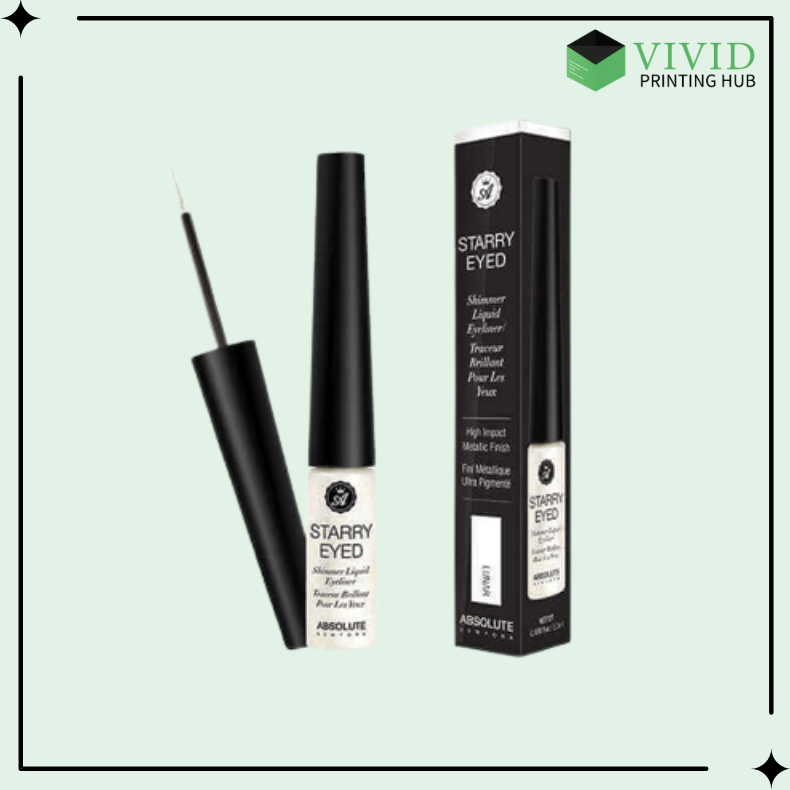


In the world of cosmetics, packaging plays a pivotal role in capturing the attention of potential customers. Among the myriad of makeup products, eyeliner is undoubtedly a staple. Therefore, it’s essential for cosmetics brands to invest in custom eyeliner boxes that not only protect their products but also reflect the essence of their brand. In this article, we’ll explore the significance of custom eyeliner boxes and how Vivid Printing Hub can help you make a lasting impression.
Starting From:
$0.80 Original price was: $0.80.$0.30Current price is: $0.30.
Product SKU: vivid-0025567

| Box Style | Custom Made Boxes |
|---|---|
| Dimension (L + W + H) | All Custom Sizes & Shapes |
| Quantities | Minimum 50 Boxes |
| Paper Stock | 52pt to 90pt |
| Printing | CMYK, PMS, No Printing |
| Finishing | Gloss Lamination, Matte Lamination, Gloss AQ, Gloss UV, Matte UV, Spot UV, Embossing, Foiling |
| Included Options | Die Cutting, Gluing, Scored, Perforation |
| Additional Options | Eco-Friendly, Recycled Boxes, Biodegradable |
| Proof | Flat View, 3D Mock-up, Physical Sampling (On request) |
| Turnaround | 15-18 Business Days And Rush Order |
| Shipping | FedEx, DHL, UPS |
A liquid eyeliner’s value depends entirely on one small component: the applicator tip seal. The fine brush tip that delivers the perfect wing — that seal is the product’s most vulnerable point. A carton that lets the tube tumble during transit, impacting the tip end against the box wall, can loosen the seal. A box too wide for the tube lets the liner rattle laterally through courier delivery. A straight-tuck bottom that opens under the weight of the tube in vertical retail display allows the liner to fall and impact the tip downward.
These are not hypothetical risks. They are the most common liquid eyeliner product failures in secondary packaging — and zero of your competitors are telling you about them because they haven’t thought about the engineering behind the box.
At Vivid Printing Hub, we manufacture custom eyeliner boxes across all five eyeliner formats — pencil, liquid tube, felt-tip pen, gel pot, and multi-pack sets — with interior dimensions confirmed to your specific format, liquid eyeliner box construction specified to prevent tip-seal impact and formula leakage, and retail channel specifications (peg display, counter display, DTC) built into the artwork and structure from the start.
MOQ from 100 units. Free complete design service. Free 3D proof before production. 10–12 business day turnaround. Free US shipping. 100% satisfaction guarantee.
Request your free quote today — same-day response.
“Eyeliner box” is not a single specification. It is five specifications — each driven by the product’s physical format.
The most common eyeliner format globally — a round or hexagonal wood or paper-wrapped pencil with a soft pigment core. Standard industry dimensions: 6–8mm diameter × 130–180mm length. The dominant retail format for mass market, indie, and clean beauty brands.
Box specification: Straight-tuck narrow carton. Cross-section 16–22mm square. Height matched to pencil length + 12–15mm closure flap allowance. The standard size cited by GoldImagePrinting and PackagingMania (0.63″ × 0.63″ × 5.5″ = 16mm × 16mm × 140mm) applies to a standard 7mm diameter pencil at 130mm length.
Product safety note: Pencil eyeliner is the most structurally robust eyeliner format — no leakage risk, minimal breakage risk unless the carton is severely crushed. The primary packaging concern is the carton’s narrow cross-section maintaining structural rigidity under peg-display hanging load.
A squeeze or pump tube with an attached fine brush or felt-tip applicator. The most delicate and safety-critical eyeliner format. Typical tube dimensions: 12–18mm Ø × 110–145mm length (tube body only); full length with tip cap: 130–180mm.
Box specification: Reverse-tuck carton — reverse-tuck base provides greater security than straight-tuck under the weight of the liquid tube in vertical display. Interior cross-section: tube diameter + 4–6mm total clearance (2–3mm per side). Interior height: full assembled length (tube + cap) + 10mm headspace.
Critical product safety engineering: See Liquid Eyeliner Leakage Prevention section below.
A pen-barrel format with a felt or fiber tip. Body diameter slightly larger than pencil liner: 14–20mm Ø × 115–145mm length. Similar box format to pencil liner but with wider cross-section.
Box specification: Straight-tuck carton, 28–35mm cross-section. The wider pen body requires a wider box than standard pencil liner — ordering a pencil liner box for a felt-tip pen eyeliner produces a product that tilts visibly within the carton.
A small wide-mouth pot containing dense gel formula, applied with a separate brush. Completely different proportions from all pen/tube formats. Typical pot dimensions: 35–55mm Ø × 20–35mm H.
Box specification: Wide-shallow micro tuck-end carton. Square or circular footprint. Interior dimensions entirely different from pen/tube formats. The most commonly incorrectly-sized eyeliner box — buyers familiar with pencil liner dimensions who order gel pot boxes at pen dimensions receive a box that is 3× too tall and 1/3 the required width.
Multiple eyeliner units (typically 2–6 coordinated shades) in a single gift-set box. The most complex eyeliner packaging format.
Box specification: Wide shallow carton or rigid box. Pencil liners in sets typically lay horizontally side-by-side. A 3-pencil set requires a box interior of approximately 25mm H × 95mm W × 155mm L. A 6-shade liquid liner set requires individual foam or cardstock slots preventing inter-liner contact.
| Eyeliner Format | Product Dimensions | Recommended Box Interior | Box Style |
|---|---|---|---|
| Standard pencil liner (7mm Ø) | 7mm Ø × 135mm L | 18mm × 18mm × 150mm | Straight-tuck carton |
| Long kohl pencil (7mm Ø) | 7mm Ø × 175mm L | 18mm × 18mm × 190mm | Straight-tuck, tall |
| Felt-tip pen eyeliner (16mm Ø) | 16mm Ø × 128mm L | 30mm × 30mm × 145mm | Straight-tuck, wider |
| Liquid brush liner (13mm Ø + tip) | 13mm Ø × 155mm full | 25mm × 25mm × 172mm | Reverse-tuck carton |
| Liquid chisel-tip liner (15mm Ø) | 15mm Ø × 150mm full | 28mm × 28mm × 168mm | Reverse-tuck carton |
| Retractable gel liner pencil (10mm Ø) | 10mm Ø × 148mm | 22mm × 22mm × 165mm | Straight-tuck carton |
| Gel pot eyeliner (45mm Ø) | 45mm Ø × 28mm H | 58mm × 58mm × 42mm | Wide-shallow tuck-end |
| 3-pack pencil liner gift set | 3 × 7mm Ø × 135mm | 25mm H × 95mm W × 150mm L | Wide flat tuck-end / rigid |
All dimensions are interior measurements. Product dimensions vary between manufacturers — provide exact measurements for precision confirmation before production.
Liquid eyeliner contains deeply pigmented, often indelible formula. A leaking liquid eyeliner in a carton permanently stains the box interior, contaminates any companion product, and — when discovered by the consumer — produces an immediate product quality failure perception that undermines brand trust.
Secondary packaging cannot make a leaking tube not leak. But it can prevent the tube from leaking by protecting the tip seal from the impacts that cause it:
The liquid eyeliner tube must sit snugly in the box interior — 2–3mm clearance per side, no more. A tube with 8–10mm of lateral play will rattle during transit and potentially impact the tip end against the box end panel under deceleration forces. We specify the interior fit for every liquid eyeliner box order based on the tube’s exact diameter — not a generic “eyeliner size.”
A straight-tuck bottom can open under the sustained weight of the liquid eyeliner tube when the box is displayed vertically (tip upward) on a retail shelf. The reverse-tuck base, with flaps locking in opposite directions, provides significantly greater base panel security. We specify reverse-tuck for all liquid eyeliner carton programs as standard.
Liquid eyeliner boxes should be displayed with the tip end upward — the formula pools at the handle end and the tip seal faces no formula pressure. On outer shipper boxes for DTC delivery, we include “This Side Up” orientation arrows as a standard element — directing the courier to keep the box tip-end upward throughout delivery.
The box interior height should match the full assembled length of the liquid liner (tube + tip cap). A box that is too tall allows the liner to rattle vertically — the cap can disengage from the tip with repeated impact. A box that is too short prevents the lid from closing cleanly and stresses the flap closure.
Liquid eyeliners are water-based or solvent-based formulas. The volatile content (water, alcohol, solvents) evaporates from the formula if the applicator tip seal is compromised or if the tip is left uncapped. The secondary packaging role: a tight-fitting carton maintains the tip cap in its pressed-closed position under slight pressure — the cap cannot be pushed back by transit vibration because the box walls provide lateral support at the cap level.
High-temperature effect: Sustained heat above 40°C increases the vapor pressure of volatile formula components, increasing the rate of evaporation through any imperfect seal. For liquid eyeliner programs shipping through warm-climate distribution (summer, outdoor markets, warm retail environments): specify cartons with reflective metallized lamination exterior — reduces radiant heat absorption and limits internal carton temperature rise during transit.
Gel eyeliner formulas use wax and polymer binders similar to pressed eyeshadow. These binders soften above 35–40°C — repeated heat cycling causes the gel surface to develop a bloomed appearance (white or grey surface film from wax recrystallization). The pot lid’s tight fit is the primary protection; the carton maintains the pot’s upright orientation and prevents the lid from loosening through transit vibration.
Pencil eyeliner cores (soft wax/pigment pressed into wooden or paper casings) can crack if the pencil experiences severe temperature cycling — expansion at high temperature followed by contraction creates internal stress. Standard carton construction provides sufficient thermal mass to buffer short-duration temperature excursions. No special lamination is required for pencil liner under standard distribution conditions.
The dominant format for pencil eyeliner, felt-tip pen liner, and retractable gel liner. Assembled from flat die-cut, self-erecting tuck-end. Most cost-efficient format at high volume. Available with or without eurohole punch for peg display.
Recommended for liquid eyeliner. Reverse-tuck base provides greater closure security than straight-tuck under vertical display load. Same flat-ship and fast-assembly efficiency as straight-tuck.
Square or nearly-square footprint, low height. The specific structural format for gel pot eyeliner — completely different proportions from all pen/tube formats. Window option available on front panel to show the gel color.
A rigid or semi-rigid tray holds the eyeliner; a printed sleeve slides over it. More premium than standard tuck-end — a mid-prestige format for pencil or liquid liner at $15–$30 retail. The sleeve is the brand canvas; the tray provides structural support.
Ultra-premium format for prestige and limited edition eyeliner ($30+). Single eyeliner in a rigid box communicates collector-level brand confidence. Also the standard for multi-product eyeliner gift sets at prestige tier.
A standard tuck-end carton with a 15–25mm header card extension above the usable interior, punched with a 4mm eurohole for retail peg hook display. The dominant format for mass retail distribution (CVS, Walgreens, Target, Ulta pharmacy section). See Peg Display section below.
Peg display is the dominant distribution format for pencil eyeliner in mass retail, pharmacy, and beauty supply channels. The peg-display carton has specific engineering requirements that differ from standard tuck-end cartons:
Eurohole punch: 4mm diameter opening, centered on the header card, positioned 5–10mm from the top edge. The hole must clear the retail peg hook (standard US retail hook gauge: 3–4mm diameter wire). Reinforcement: eurohole reinforcement with a plastic eyelet is recommended for heavy eyeliners — prevents the punch from tearing under the weight of the suspended box.
Header card panel: The top extension (15–25mm above the box interior top) serves as the display facing — the surface visible to the consumer scanning across a peg display. The header card carries: brand mark, product name, and color swatch or product image. Limited to approximately 60mm × 25mm display area for standard pencil liner width.
Box weight calculation: The carton must support its own weight in a suspended position from the eurohole. A standard tuck-end eyeliner carton (pencil liner, 14pt SBS) weighs approximately 8–12g assembled — well within standard peg display load limits. However, multi-pack display cartons (3-pack pencil liner) can reach 40–60g — requiring reinforced eurohole punch with eyelet.
Barcode placement: Scannable barcode on the back face of the carton, vertically oriented, 30mm from the bottom edge. Standard ITF-14 or UPC-A barcode format for mass retail compliance.
Counter display boxes allow indie brands to enter physical retail with a full eyeliner range displayed in a single organized unit — without requiring individual peg-hook cartons.
Standard configurations:
The counter display box exterior is a brand canvas — the collection name, brand mark, and individual shade identifiers visible from 3–4 feet of retail approach distance. We design the counter display box exterior and the individual eyeliner carton inserts as a coordinated visual system.
Eyeliner products sold in the US market are classified as cosmetics by the FDA and must carry specific label information on their secondary packaging:
Product identity statement: “Eye Liner,” “Liquid Eye Liner,” “Eye Pencil,” “Kohl Eye Pencil,” etc. on the principal display panel.
Net content: Weight (oz/g) in both US and metric units. For pencil eyeliner, this is typically stated as net weight (e.g., “0.04 oz / 1.1 g”). For liquid liner: fluid volume in fl oz/mL.
Ingredient declaration (INCI): Full ingredient list in descending order of predominance on the principal display panel or immediately adjacent. Minimum 1/16″ type size on packages with principal display panel over 2 sq in.
Manufacturer/Distributor name and US address.
Color additive compliance for eye area cosmetics: Eyeliner is an eye area cosmetic — FDA regulations (21 CFR Part 74) restrict which color additives can be used in eye area products. Not all color additives that are approved for general cosmetic use are approved for eye area use. Color additives in eyeliner must be listed as approved for eye area use in the FDA color additive regulations. This compliance obligation extends to the packaging artwork — the product color imagery on the carton must not misrepresent the eyeliner’s actual approved color.
This is general regulatory guidance, not legal advice. Consult an FDA regulatory specialist for specific formulation compliance.
We design required label elements — product identity, net content, INCI list space, manufacturer address, and FDA compliance review for color name claims — into the standard box artwork as part of the free design service.
| Eyeliner Retail Price | Packaging Tier | Recommended Format | Exterior | Interior |
|---|---|---|---|---|
| $3–$10 (mass market) | Standard retail | Tuck-end + peg hole | Gloss UV, CMYK | None |
| $10–$20 (indie/accessible) | Entry premium | Tuck-end soft-touch | Soft-touch matte, spot UV | None |
| $20–$35 (mid-prestige) | Premium retail | Sleeve and tray | Soft-touch matte + foil | None |
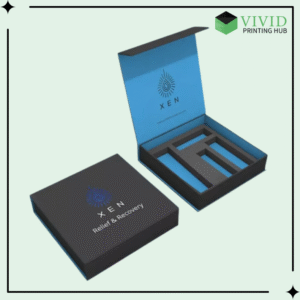
| $35+ (prestige/collector) | Ultra-premium | Magnetic closure rigid | Soft-touch matte + gold foil | Foam slot or velvet base |
Key rule: A $30 prestige eyeliner in a gloss tuck-end carton — identical in appearance to the $5 drugstore liner beside it — creates a pricing dissonance that undermines the prestige positioning at first shelf glance. The packaging must communicate the tier without the consumer reading the price tag.
For natural, organic, and clean beauty eyeliner brands:
Board: FSC-certified SBS (full-color print on white substrate) or FSC-certified natural kraft (most coherent with botanical/natural aesthetic).
Inks: Water-based or soy-based exclusively. For brands claiming “no synthetic fragrance” or “all-natural ingredients” — UV-cured inks off-gas trace volatile compounds that can conflict with product-level claims.
Coating: Aqueous matte (water-based, no plastic film, curbside recyclable). No BOPP plastic lamination for fully recyclable carton programs.
Color additives: For kohl and kajal eyeliners claiming “natural pigments” or “mineral-based” — verify FDA eye area approval for all mineral pigments used (iron oxides and certain ultramarines are approved; some natural pigment extracts are not approved for eye area use). We flag potential color additive compliance issues during design review.
Documentation: FSC chain-of-custody certificate, material composition declaration, ink SDS — the documentation package for Sephora Clean, Ulta Conscious Beauty, Target Clean, and Credo Beauty vendor program applications.
Full-Color CMYK Offset — Standard for all eyeliner carton formats at 500+ units. Bold, on-brand color graphics. PMS Spot Color — Brand-standard color accuracy for eyeliner ranges where carton color must match shade identity (a “midnight black” eyeliner should be in a midnight black carton; the carton color communicates the product color to the peg-display consumer). Digital Printing — Short-run, 100+ units, no plate cost. Standard for launches, limited editions, and multi-shade range testing. Soft-Touch Matte Lamination — Premium surface for mid-prestige and prestige eyeliner ranges.
Gloss UV Coating — Maximum shelf vibrancy for mass market peg-display eyeliner. Spot UV over Matte — Brand mark, logo, or color swatch highlight on a matte base. Gold / Silver / Rose Gold Foil Stamping — Available for all pt weights 14pt+. Holographic Lamination — Prismatic shimmer for color cosmetics brands with high-impact retail presence objectives. Window Cut-Out — For gel pot eyeliner: a window shows the gel color through the closed box, communicating shade without opening. For pencil liners in multi-packs: a window reveals the pencil tip color. Eurohole Punch — Standard peg-display addition for all pencil liner carton programs.
MOQ: 100 units. Standard Turnaround: 10–12 business days from artwork approval. Rush Production: Available for launch programs, seasonal campaigns, and retail deadlines. Volume Tiers: 100 / 500 / 1,000 / 2,500+ units. Free US Shipping on qualifying orders. Free 3D Digital Proof — Product-in-box visualization included. Free FDA Label Design Review — Product identity, INCI space, eye area color additive flag. 100% Satisfaction Guarantee.
Format Confirmation — We confirm whether your eyeliner is pencil, liquid tube, felt-tip pen, gel pot, or multi-pack and specify the correct interior dimensions for each — not a generic “eyeliner size.”
Liquid Eyeliner Safety Engineering — Reverse-tuck base, tight interior fit (2–3mm per side), tip-end orientation marking, and full-height interior support — the complete leak-prevention specification for liquid liner programs.
Peg Display Specification — Eurohole punch, header card dimensions, barcode placement, and reinforcement eyelet for multi-pack weight — built in from the start for mass retail programs.
FDA Compliance Design Review — Required label elements and eye area color additive flag included in standard design service.
Clean Beauty Documentation — FSC chain-of-custody, material composition declarations, ink SDS for Sephora Clean, Ulta Conscious Beauty, Credo Beauty vendor applications.
Free Complete Design Service — Exterior, INCI panel, peg display header, counter display system — all surfaces at zero additional cost.
Free 3D Proof before production.
100% Satisfaction Guarantee.
What size box do I need for my eyeliner? It depends on your specific eyeliner format and dimensions. For a standard pencil eyeliner (7mm diameter × 135mm length), the industry standard is approximately 18mm × 18mm × 150mm interior — which is the equivalent of the commonly cited 0.63″ × 0.63″ × 5.5″ standard. For a liquid brush liner with tip (13mm Ø, 155mm total length), the correct interior is approximately 25mm × 25mm × 172mm — significantly larger than the pencil liner standard. For a gel pot eyeliner (45mm Ø × 28mm height), you need a completely different format: approximately 58mm × 58mm × 42mm. Provide your eyeliner’s exact diameter and length and we confirm the correct interior dimensions before production.
How do I prevent my liquid eyeliner from leaking in the box? Secondary packaging can’t fix a leaking tube, but it can prevent the tube from causing its own seal failure. Specify a reverse-tuck carton (base provides greater security than straight-tuck under vertical display load), interior fit of 2–3mm clearance per side (prevents lateral rattling and tip impact), and full-height interior support (box height matches the full assembled tube + cap length). Include a “This Side Up” orientation marking on your outer shipper — liquid liners should be transported tip-end upward to keep formula away from the tip seal. We incorporate all these specifications as standard for liquid eyeliner programs.
What is the difference between a box for pencil eyeliner vs. liquid eyeliner? Pencil liner uses a straight-tuck carton (16–22mm square cross-section, height matched to pencil length). Liquid liner requires a reverse-tuck carton (for base security), slightly wider cross-section to accommodate the applicator tube diameter, and taller interior to accommodate the tube with cap. The reverse-tuck base is critical for liquid liner — it prevents the base from opening under the weight of the filled tube in vertical retail display, which would allow the liner to fall and impact the tip applicator.
Do eyeliner boxes need a eurohole for peg display? For mass retail, pharmacy, and drugstore distribution (CVS, Walgreens, Target beauty section, Ulta), yes — the eurohole punch is the standard peg display mechanism. We add a 15–25mm header card extension to the top of the carton with a 4mm eurohole centered and reinforced. The header card carries your brand mark and product name. The barcode goes on the back face, 30mm from the bottom edge, vertically oriented for retail scanner compatibility. Tell us your distribution channel when ordering and we incorporate peg display specification from the initial design.
What FDA labeling is required on eyeliner packaging? US cosmetic eyeliner packaging requires: product identity statement (“Eye Liner,” “Liquid Eye Liner,” etc.), net content in US and metric units, full INCI ingredient declaration in descending order, and manufacturer or distributor name and US address. Additionally, eyeliner is an eye area cosmetic — color additives used must be FDA-approved specifically for eye area use under 21 CFR Part 74. This includes natural and mineral pigments — not all “natural” pigments are approved for eye area use. We include a FDA compliance design review for all eyeliner programs, flagging any potential color name or color additive labeling issues before production.
Can eyeliner boxes work for all eyeliner types — pencil, liquid, and gel pot? Yes — but each requires a different box specification. Pencil liner: straight-tuck narrow carton (18mm × 18mm cross-section). Liquid liner: reverse-tuck slightly wider carton (25–30mm cross-section), taller interior. Felt-tip pen liner: straight-tuck, wider cross-section (30–35mm). Gel pot: wide-shallow tuck-end with square footprint (58mm × 58mm). If you sell multiple eyeliner formats in a range, we produce each format with its correct interior dimensions while maintaining a coordinated exterior design system across the range.
What is the minimum order for custom eyeliner boxes? Our minimum order is 100 units — significantly lower than some competitors (UrgentBoxes requires 500 units minimum). Volume pricing improves at 500, 1,000, and 2,500+ units. For multi-shade ranges (e.g., 12 shades × 100 units each = 1,200 total), we structure the production as a single run with per-shade CMYK variation, achieving single-run pricing across the full range.
An eyeliner box has one non-negotiable job before any brand communication consideration: keep the tip sealed. Everything else — the color, the foil, the soft-touch matte surface, the perfect carton color-match to the shade inside — communicates your brand. But the tip seal is what communicates your product’s quality.
At Vivid Printing Hub, we engineer eyeliner boxes that do both: the correct interior dimensions for your specific eyeliner format, the correct closure construction for your formula type, the correct peg display specification for your retail channel, and the exterior aesthetic calibrated to your brand’s positioning tier.
Call us: +1 (786) 619-8471 Email us: sales@vividprintinghub.com
Request Your Free Eyeliner Box Quote — Format Confirmation Included, Liquid Leakage Spec, Peg Display Engineering, FDA Label Review, Same-Day Response
Our MOQ varies depending on the product type and customization requirements. We can start with as few as 5 or 50 boxes and scale up to thousands, with pricing adjusting accordingly. For specific details on your product, feel free to reach out—we’re happy to assist with orders of all sizes!
Our delivery timeline ranges from 5 to 20 business days, depending on order quantity and customization requirements. We offer both standard turnaround and rush services for faster delivery. Contact us to discuss the best option for your needs!
Yes! We provide Random Sample Kits as well as Custom Physical Prototypes of your box before bulk production for approval. Depending on the order quantity, samples may be offered free of charge. You can also order a standalone prototype if needed. Contact us to learn more!
Absolutely! Our professional designers are here to help craft the perfect design for your custom packaging—free of charge. Whether you have a rough sketch, an idea, or need a complete box template, we’ll work closely with you to bring your vision to life. We also provide 3D mockups and repeated digital proofs to ensure everything aligns perfectly with your brand and product needs before production.
The ideal box size depends on your product’s dimensions, weight, and protection requirements. Simply provide the exact length, width, and height, and we’ll handle the rest! Alternatively, you can share a product link or CAD drawing for precise customization. If you’re unsure, our experts are here to help with tailored recommendations, 3D mockups, and digital proofs to ensure a perfect fit.
The cost of a custom box depends on several factors:
Color Printing: Printing 1-2 colors or full-color on the outside doesn’t impact cost significantly, but inside printing adds to the price.
Box Structure: Flat-shipped boxes are more cost-effective, while pre-assembled boxes are pricier due to volume and shipping considerations.
Customization & Materials: Specialty finishes, coatings, and high-end materials also influence pricing.
For a precise quote, feel free to reach out!
Yes! Our pricing is volume-based, meaning larger orders come with better price breaks. The more you order, the lower the cost per unit. If you’re considering a bulk purchase, reach out to our team for a customized quote!
Yes! We provide exclusive reseller pricing for businesses ordering in bulk or frequently. If you’re a reseller, distributor, or packaging supplier, contact us to discuss custom pricing, discounts, and partnership opportunities tailored to your needs.
Sam Carter
Sales Manager
Hi there! I’m looking for custom packaging boxes. Can you help me out?