
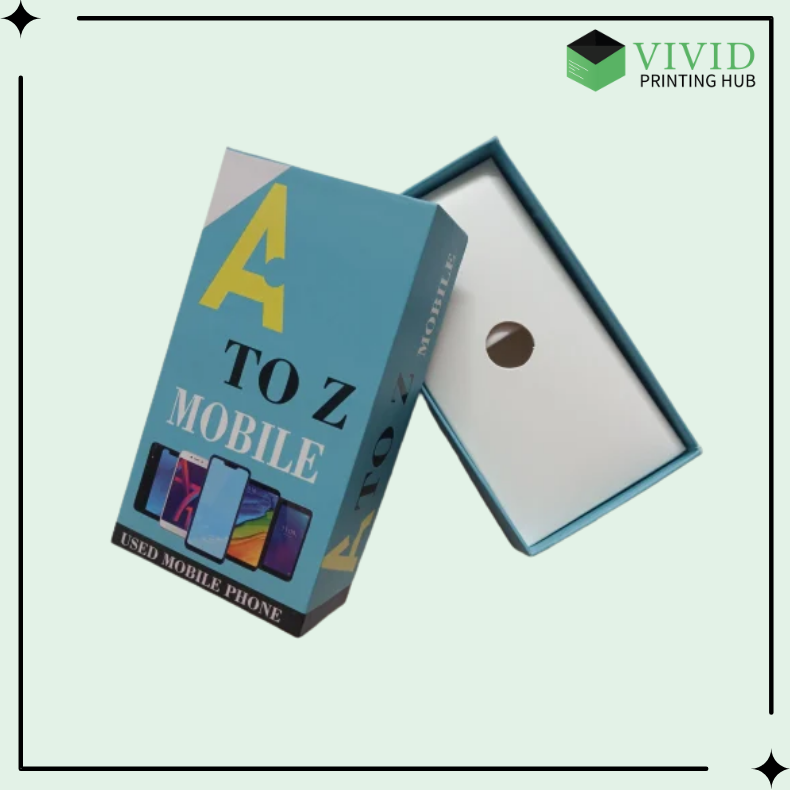


In today’s fast-paced world, where first impressions matter more than ever, businesses are constantly seeking ways to stand out and leave a lasting impact on their customers. One effective way to achieve this is through the use of custom cell phone rigid boxes. Vivid Printing Hub, a leader in the printing and packaging industry, offers a range of high-quality custom cell phone rigid boxes that not only protect your products but also enhance your brand’s image. In this article, we will explore the benefits of choosing Vivid Printing Hub for your custom cell phone rigid boxes and how this simple yet effective packaging solution can help your brand thrive.
Starting From:
$5.00 Original price was: $5.00.$3.50Current price is: $3.50.
Product SKU: vivid-002557868

| Box Style | Custom Made Boxes |
|---|---|
| Dimension (L + W + H) | All Custom Sizes & Shapes |
| Quantities | Minimum 50 Boxes |
| Paper Stock | 52pt to 90pt |
| Printing | CMYK, PMS, No Printing |
| Finishing | Gloss Lamination, Matte Lamination, Gloss AQ, Gloss UV, Matte UV, Spot UV, Embossing, Foiling |
| Included Options | Die Cutting, Gluing, Scored, Perforation |
| Additional Options | Eco-Friendly, Recycled Boxes, Biodegradable |
| Proof | Flat View, 3D Mock-up, Physical Sampling (On request) |
| Turnaround | 15-18 Business Days And Rush Order |
| Shipping | FedEx, DHL, UPS |
The smartphone packaging standard was set by Apple — and every phone brand, accessory company, refurbishment operator, and mobile retailer in the market is now being judged against it.
The Apple iPhone box opens with a slow, air-resistance-controlled pull that feels engineered. The phone sits face-up in a precisely fitted foam cavity — perfectly level, perfectly centered, perfectly presented. Below it, a secondary tray holds the charging cable and accessories in individual contoured compartments. The entire experience communicates that the product inside is worth the price.
That experience is not accidental. It is the result of model-matched dimensions, contour-cut foam insert engineering, controlled lid friction tolerances, and an accessory compartment sequence designed for the reveal. At Vivid Printing Hub, we manufacture custom cell phone rigid boxes to that same engineering standard — for phone brands, mobile retailers, refurbishment operators, accessory companies, and PR kit programs — from 100 units with a free 3D proof before production begins.
MOQ from 100 units. Free complete design service. Free 3D proof. 10–12 business day turnaround. 100% satisfaction guarantee.
Request your free quote today — same-day response.
The first question every cell phone rigid box buyer needs answered is: what dimensions does my box need to be? Box interior dimensions must accommodate the phone’s footprint plus a precisely controlled clearance — enough to allow insertion without force, but tight enough to prevent the phone from shifting inside the box during shipping.
Standard foam insert construction adds 8mm–15mm to the phone’s outer dimensions on each face — the foam cavity depth on each side. Box interior dimensions therefore equal phone outer dimensions plus total foam insert allowance.
Reference: Most Commonly Packaged Smartphone Models
| Phone Model | Height × Width × Depth | Recommended Box Interior (with foam) |
|---|---|---|
| iPhone 16 | 147.6 × 71.6 × 7.8mm | ~175 × 99 × 30mm |
| iPhone 16 Plus | 160.9 × 77.8 × 7.8mm | ~189 × 105 × 30mm |
| iPhone 16 Pro | 149.6 × 71.5 × 8.3mm | ~178 × 99 × 32mm |
| iPhone 16 Pro Max | 163.0 × 77.6 × 8.3mm | ~191 × 105 × 32mm |
| Samsung Galaxy S25 | 146.9 × 70.5 × 7.2mm | ~175 × 98 × 29mm |
| Samsung Galaxy S25+ | 158.4 × 75.8 × 7.3mm | ~187 × 103 × 29mm |
| Samsung Galaxy S25 Ultra | 162.8 × 77.6 × 8.2mm | ~191 × 105 × 31mm |
| Google Pixel 9 | 152.1 × 71.8 × 8.5mm | ~181 × 100 × 32mm |
| Google Pixel 9 Pro | 152.8 × 72.0 × 8.5mm | ~181 × 100 × 32mm |
| OnePlus 13 | 162.9 × 76.5 × 8.5mm | ~191 × 104 × 32mm |
All recommended box interior dimensions are for standard single-layer foam insert construction. Multi-compartment (phone + accessories) boxes require additional base depth — typically 55mm–80mm total interior height. Contact us with your specific phone model and accessory list for exact dimension confirmation.
A cell phone rigid box sold to a consumer or gifted as a PR kit is almost never just a phone box. It is a complete product system — and the insert engineering must reflect that.
The simplest configuration — one foam layer contour-cut precisely to the phone’s dimensions. The phone sits face-up in a fitted EVA foam cavity. Used for: refurbishment packaging (phone-only, no accessories), accessory brand packaging (phone as display reference), retail display boxes.
EVA foam specifications: Closed-cell EVA foam, 30–45 shore hardness (firm enough to immobilize the phone, soft enough to cushion impact). Cavity depth: phone thickness plus 3–5mm below the phone surface ensures the screen sits above the foam cavity rim — preventing lid contact with the screen.
The most common configuration for branded phone packaging. Upper layer: phone cavity. Lower layer: accessory tray with individual compartments.
Standard accessory compartment layout (lower layer):
Layer transition: A cardboard lift card or ribbon pull between the phone layer and accessory layer signals the consumer to look below — maintaining the reveal sequence and preventing accessories from being missed.
For premium phone gift sets, influencer PR kits, and flagship launch packaging — three layers with a defined reveal sequence:
The OEM-grade insert used by Apple, Samsung, and premium Android brands. Injection-molded or vacuum-formed clear or white plastic tray with precision-molded compartments for each component. Higher tooling cost — cost-effective at 5,000+ units. Produces a cleaner, more product-visible interior than foam. Used by brands benchmarking against OEM packaging standards.
The cell phone screen is the most expensive and most fragile component of any smartphone — and the component most at risk from packaging failure during transit. Engineering the rigid box to prevent screen damage is the highest-priority protection function.
Foam Cavity Depth (Screen Protection) — The phone’s screen must sit at or below the foam cavity rim when the lid is placed. If the screen protrudes above the foam surface and contacts the lid top during a drop event, the lid transmits impact force directly to the glass. Standard: foam cavity depth = phone thickness + 3mm minimum above screen surface.
Corner Cushion Extensions — The four corners of a smartphone are the highest-impact points in a drop event — where the phone’s momentum concentrates on the smallest contact area. Extended foam corner cushions — thicker foam at the four corner positions of the cavity — provide additional attenuation at the points of maximum impact vulnerability.
EVA Foam Shore Hardness — Too soft (below 25 shore A) and the foam compresses fully under moderate impact, allowing the phone to bottom out against the chipboard base. Too hard (above 50 shore A) and the foam transmits rather than absorbs impact energy. Optimal range: 30–45 shore A for phone inserts.
Secondary Impact Protection (Drop-Test Packaging) — For brands shipping phone boxes directly to consumers via e-commerce or requiring carrier-certified drop-test performance: outer corrugated shipper box with 50mm–75mm foam or corrugated padding on all six faces. This is the standard for e-commerce phone fulfillment. We engineer the outer shipper system as part of the complete packaging solution.
The premium phone unboxing experience is not a marketing concept — it is a set of engineering specifications that produce a specific consumer sensory sequence.
The signature Apple-style slow lid pull is produced by engineering the lid-to-base clearance to a tighter tolerance (1.5mm–2mm vs. the standard 2mm–3mm) combined with a sealed interior — the foam insert creates a near-airtight interior space that generates air resistance as the lid lifts. This resistance slows the lid pull to a controlled, deliberate pace. Result: the consumer experiences the lid as “quality-weighted” rather than loose or rushed.
A magnetic closure strip embedded in the lid and base creates a gentle attractive force that holds the lid in place and produces a satisfying soft-close snap when the box is closed. Used in premium phone brand packaging and gifting formats where the box will be reused as a storage or display item by the consumer.
A satin ribbon positioned under the phone in the foam cavity — folded against the foam surface when packed — allows the consumer to extract the phone by pulling the ribbon upward, lifting the phone elegantly from its cavity without touching the screen or sides. The ribbon lift transforms phone extraction from a functional act into a brand experience moment.
The reveal sequence — the order in which the consumer discovers the contents — is a design decision with brand equity implications. The professional standard: phone always first (the hero product, face-up, immediately visible on box opening), accessories below (maintaining anticipation and rewarding further exploration), documentation last (below accessories, never visible on first open).
A tissue paper or branded inner sleeve over the top of the foam layer — removed by the consumer before seeing the phone — creates a deliberate pause in the unboxing sequence that heightens anticipation. Used in premium gifting and influencer PR kit packaging.
Separate lid and base, lid fits over the base. The Apple-standard format. Full product display when lid is removed. Best for retail presentation, gifting, and any application where the full phone reveal is the primary experience goal.
Single-piece construction with hinged lid and magnetic closure strip. Self-closing, reusable by the consumer. Used in premium gifting, carrier retail, and influencer PR kits where the box will be kept and reused.
Sliding inner tray pulled from an outer sleeve. The sliding reveal creates a distinctive opening experience. Used in premium phone accessories and mid-tier phone brands differentiating from standard lid-and-base format.
An inner tray holding the phone slides within a printed outer sleeve. Lightweight and relatively compact. Used for phone accessories and mid-range phone packaging where cost is a constraint.
Ships flat, assembles at fulfillment. Ideal for DTC brands shipping phone boxes directly to consumers — reduces inbound shipping cube significantly vs. pre-assembled rigid boxes. Produces a rigid, premium appearance when assembled. Not suitable for thermoform insert construction (requires flat-pack compatibility).
Phone brands producing original equipment packaging require model-matched precision dimensions, drop-test certified insert construction, scalable volume production (5,000–500,000+ units), and thermoform or contour foam insert tooling. Branding requirements: brand color system, precise logo placement, regulatory compliance labels (FCC, CE, battery safety, WEEE recycling symbol). Contact us for OEM volume programs.
Independent phone retailers, carrier storefronts, and authorized resellers need branded packaging that communicates retail-channel credibility — elevating their product presentation beyond the consumer expectation of a generic white box. Custom branded rigid box with full-color printing, foam insert, and accessory compartments at 100–2,500 unit volumes.
The CPO and refurbishment market is one of the fastest-growing segments in the cell phone channel. CPO brands (Back Market, carrier CPO programs, independent refurbishers) need premium rigid boxes that signal quality and certification credibility — replacing the original OEM box with packaging that supports the certification claim. Specific requirements: “Certified Pre-Owned,” “Grade A Refurbished,” or carrier certification mark placement; clean, premium aesthetic communicating quality inspection; foam insert for display presentation. CPO box volumes typically 500–10,000 units per program run.
Cases, screen protectors, wireless chargers, cables, earphones, and MagSafe accessories are all sold in the premium retail space alongside phones. Rigid boxes for accessories need phone-adjacent branding aesthetics (clean, tech-minimal design language), hang-tab retail display options for peg display merchandising, and often a window cut in the lid or base to display the accessory through the packaging.
Corporate gifting programs using phones and phone accessories as gifts require custom branded rigid boxes with corporate color systems, foil-embossed company logo, ribbon pull, multi-compartment accessory configuration, and personalized insert card. Volumes typically 100–2,500 units per gifting program.
Smartphone brands, accessory brands, and mobile tech companies send PR kits to influencers in premium rigid boxes designed specifically for the unboxing video format. PR kit requirements: high visual impact exterior (unboxing thumbnail appeal), premium multi-compartment interior (phone/device + accessories + brand materials + personalized message), magnetic closure for self-closing reveal shots, and social-media-optimized brand presentation. Contact us for PR kit rigid box programs.
Full-Color CMYK Offset Printing — The standard for premium branded cell phone packaging. Full photographic quality across all exterior surfaces — lid top, lid sides, base sides.
PMS Spot Color — Essential for tech brands with precise brand color standards. Guarantees consistent color reproduction run-to-run.
Soft-Touch Matte Lamination — The most widely used surface treatment in premium consumer electronics packaging. Produces a warm, velvety matte surface that communicates quality at touch. Fingerprint-resistant — important for phone packaging handled repeatedly in retail environments.
Gloss UV Lamination — High-shine, moisture-resistant surface. High visual impact at retail. Used in mid-range and sports/gaming phone brand aesthetics.
Spot UV — Selective gloss coating applied to logo marks, brand wordmarks, and design elements over a matte base. Creates high-contrast visual emphasis — the premium branding technique for tech packaging.
Gold / Silver Foil Stamping — Metallic foil on brand marks and design elements. Used in premium and limited-edition phone packaging.
Embossing / Debossing — Dimensional brand mark treatment. Debossing (recessed) is the dominant technique in premium tech packaging — communicates restraint and precision.
Leatherette Wrap — Textured leatherette paper wrap — used in luxury phone brand positioning and premium gifting formats.
FSC-Certified Chipboard and Wrap Paper — Chain-of-custody documentation for brands with sustainability vendor program requirements.
Recycled Content Chipboard — Post-consumer recycled chipboard available as an eco-positioning option.
Biodegradable Foam Inserts — Plant-based and biodegradable foam alternatives replacing petroleum-based EVA foam — available for brands with plastic-free or biodegradable packaging commitments.
Plastic-Free Interior — Paper-based or cardboard insert alternatives to thermoform plastic trays — eliminating plastic from the interior entirely.
Water-Based Adhesives — Non-toxic, VOC-free adhesive construction throughout.
WEEE and Battery Compliance Symbols — We format all required electronics recycling (WEEE) and battery disposal compliance symbols correctly on your packaging design for EU distribution and electronics retail regulatory compliance.
MOQ: 100 units — professional branded cell phone rigid boxes from your first production run. Standard Turnaround: 10–12 business days from artwork approval. Rush Production: Available for launch deadlines and PR kit programs. Volume Tiers: 100 / 500 / 1,000 / 5,000+ units. Free US Shipping on qualifying orders. Free 3D Digital Proof before production. 100% Satisfaction Guarantee.
Model-Matched Dimension Engineering — We confirm box interior dimensions against your specific phone model measurements — not a generic “fits most phones” template.
Multi-Compartment Insert Design — We engineer the complete insert system: phone cavity, accessory compartments, ribbon lift, thermoform options — the full unboxing sequence, not just a foam pad.
Unboxing Experience Mechanics — Lid friction tolerance, magnetic closure, ribbon lift, accessory reveal sequence — we design the unboxing experience, not just the box.
Drop-Test Protection Engineering — EVA foam shore hardness selection, corner cushion extensions, outer corrugated shipper compatibility — protection built in from specification.
Free Complete Design Service — All exterior surfaces, insert specification, insert card design — zero additional cost.
Free 3D Digital Proof — Approve every surface and every interior configuration in photorealistic 3D.
10–12 Day Standard Turnaround — Consistent for retail launches, PR kit programs, and reorder cycles.
100% Satisfaction Guarantee — Matches your approved proof or we reprint/refund unconditionally.
Step 1 — Share Your Phone and Accessory Details Tell us your phone model(s), accessories included, desired box format (two-piece, magnetic, drawer), insert type (foam, thermoform), finishes, and volume. We provide dimension confirmation and quote same business day.
Step 2 — Design, Insert Engineering, and Compliance Review Our team creates complete exterior artwork and engineers the full insert system — phone cavity dimensions, accessory compartments, ribbon lift position, and regulatory symbol placement.
Step 3 — Approve Your 3D Proof Review every exterior surface and interior insert configuration in photorealistic 3D. All revisions free.
Step 4 — Production and Delivery Ships in 10–12 business days from artwork approval.
Call us: +1 (786) 619-8471 Email us: sales@vividprintinghub.com
How do I confirm the right box dimensions for my specific phone model? We confirm dimensions against your exact phone model measurements. Standard approach: box interior width = phone width + 16mm–20mm (8mm–10mm foam on each side); box interior height = phone height + 16mm–20mm; box interior depth = phone thickness + 35mm–50mm for single-layer foam insert, or 65mm–80mm for two-layer phone-plus-accessories insert. Our reference table covers all major current iPhone, Samsung Galaxy, Google Pixel, and OnePlus models. Share your specific phone model and we provide exact dimension confirmation before production.
What insert construction best protects a smartphone during shipping? For transit protection, we recommend closed-cell EVA foam at 30–45 shore A hardness with the following specifications: phone cavity depth = phone thickness + 3mm minimum above the screen surface (preventing lid-to-screen contact), extended corner cushion zones at all four phone corners, and foam sidewall height matching or exceeding the phone’s full body depth. For e-commerce shipping, add an outer corrugated shipper box with 50mm–75mm foam or corrugated padding on all six faces. This combination provides drop-test protection appropriate for standard carrier handling (24″–36″ drop heights).
Can you engineer a multi-compartment insert for phone plus accessories? Yes — multi-compartment insert engineering is one of our core specializations. We design the full insert system: upper layer phone cavity with ribbon lift, lower layer accessory tray with individual compartments for charger, cable, earphones, SIM tool, and documentation. We confirm compartment dimensions against your specific accessory dimensions — not generic sizes. Contact us with your phone model and full accessory list.
What is the difference between EVA foam and thermoform inserts for phone packaging? EVA foam inserts are die-cut or contour-cut from closed-cell foam — cost-effective at all volumes from 100 units up, highly customizable, available in black, white, grey, and custom colors. Thermoform plastic tray inserts are vacuum-formed from rigid plastic — producing a cleaner, more product-visible interior with higher precision molded pockets. Thermoform requires tooling investment — most cost-effective at 5,000+ units. OEM phone brands typically use thermoform; independent retailers and gifting programs typically use EVA foam.
What is the minimum order for cell phone rigid boxes? Our minimum order is 100 units — appropriate for new brand launches, independent retail programs, PR kit programs, and market testing. Volume pricing improves at 500, 1,000, and 5,000+ units. Thermoform insert tooling is most cost-effective at 5,000+ units.
Do you produce packaging for certified pre-owned / refurbished phones? Yes — CPO and refurbishment packaging is one of our growing specialty programs. We produce premium rigid boxes with “Certified Pre-Owned,” “Grade A Refurbished,” or carrier certification mark formatting, foam insert for display-quality phone presentation, and optional accessory compartments for included accessories. CPO packaging communicates quality and certification credibility — replacing or upgrading the original OEM box with packaging that supports the certification claim and the premium pricing it enables.
What finish is best for a premium phone brand packaging aesthetic? Soft-touch matte lamination is the dominant finish choice for premium consumer electronics packaging — it produces a warm, velvety matte surface that communicates quality at first touch and is fingerprint-resistant in retail handling. Combined with spot UV on the brand mark (gloss over matte) and debossed logo mark, this is the industry-standard finish combination for flagship phone packaging. For ultra-premium or limited edition positioning, leatherette wrap with foil-stamped branding is the alternative premium finish choice.
Can you produce collapsible rigid boxes for DTC phone fulfillment? Yes. Collapsible rigid boxes ship flat and assemble at your fulfillment center — significantly reducing inbound shipping cube vs. pre-assembled rigid boxes. The assembled box produces a rigid, premium appearance indistinguishable from a standard rigid box. Not compatible with thermoform insert construction (thermoform requires pre-assembled box). Compatible with EVA foam inserts. Recommended for DTC brands with high-volume fulfillment operations where shipping cube reduction has significant logistics cost impact.
How long does production take for cell phone rigid boxes? Standard production is 10–12 business days from artwork approval. Rush production is available for launch deadlines and PR kit programs. For multi-model programs (e.g., iPhone 16 + iPhone 16 Pro + iPhone 16 Pro Max variants), production runs simultaneously for all models — turnaround remains 10–12 business days from final artwork approval across all variants.
Do you include WEEE and battery compliance symbols on electronics packaging? Yes. We format all required regulatory compliance symbols — WEEE electronics recycling symbol, CE mark, FCC ID, battery disposal symbol — correctly in your packaging design for EU distribution, carrier retail, and electronics retail regulatory compliance. We confirm compliance symbol requirements for your specific distribution markets before production.
Premium phone packaging communicates before the consumer touches the product. The weight of the box, the resistance of the lid, the precision of the insert, the sequence of the reveal — each element signals the quality of what is inside.
At Vivid Printing Hub, we engineer every dimension of that experience — from chipboard grade and foam shore hardness to accessory compartment layout and ribbon lift position — with the precision your phone product deserves and the brand authority your market demands.
Call us: +1 (786) 619-8471 Email us: sales@vividprintinghub.com
Request Your Free Cell Phone Rigid Box Quote — Same-Day Response, Free Complete Design, Free 3D Proof, Dimension Confirmation Included
Our MOQ varies depending on the product type and customization requirements. We can start with as few as 5 or 50 boxes and scale up to thousands, with pricing adjusting accordingly. For specific details on your product, feel free to reach out—we’re happy to assist with orders of all sizes!
Our delivery timeline ranges from 5 to 20 business days, depending on order quantity and customization requirements. We offer both standard turnaround and rush services for faster delivery. Contact us to discuss the best option for your needs!
Yes! We provide Random Sample Kits as well as Custom Physical Prototypes of your box before bulk production for approval. Depending on the order quantity, samples may be offered free of charge. You can also order a standalone prototype if needed. Contact us to learn more!
Absolutely! Our professional designers are here to help craft the perfect design for your custom packaging—free of charge. Whether you have a rough sketch, an idea, or need a complete box template, we’ll work closely with you to bring your vision to life. We also provide 3D mockups and repeated digital proofs to ensure everything aligns perfectly with your brand and product needs before production.
The ideal box size depends on your product’s dimensions, weight, and protection requirements. Simply provide the exact length, width, and height, and we’ll handle the rest! Alternatively, you can share a product link or CAD drawing for precise customization. If you’re unsure, our experts are here to help with tailored recommendations, 3D mockups, and digital proofs to ensure a perfect fit.
The cost of a custom box depends on several factors:
Color Printing: Printing 1-2 colors or full-color on the outside doesn’t impact cost significantly, but inside printing adds to the price.
Box Structure: Flat-shipped boxes are more cost-effective, while pre-assembled boxes are pricier due to volume and shipping considerations.
Customization & Materials: Specialty finishes, coatings, and high-end materials also influence pricing.
For a precise quote, feel free to reach out!
Yes! Our pricing is volume-based, meaning larger orders come with better price breaks. The more you order, the lower the cost per unit. If you’re considering a bulk purchase, reach out to our team for a customized quote!
Yes! We provide exclusive reseller pricing for businesses ordering in bulk or frequently. If you’re a reseller, distributor, or packaging supplier, contact us to discuss custom pricing, discounts, and partnership opportunities tailored to your needs.
Sam Carter
Sales Manager
Hi there! I’m looking for custom packaging boxes. Can you help me out?