
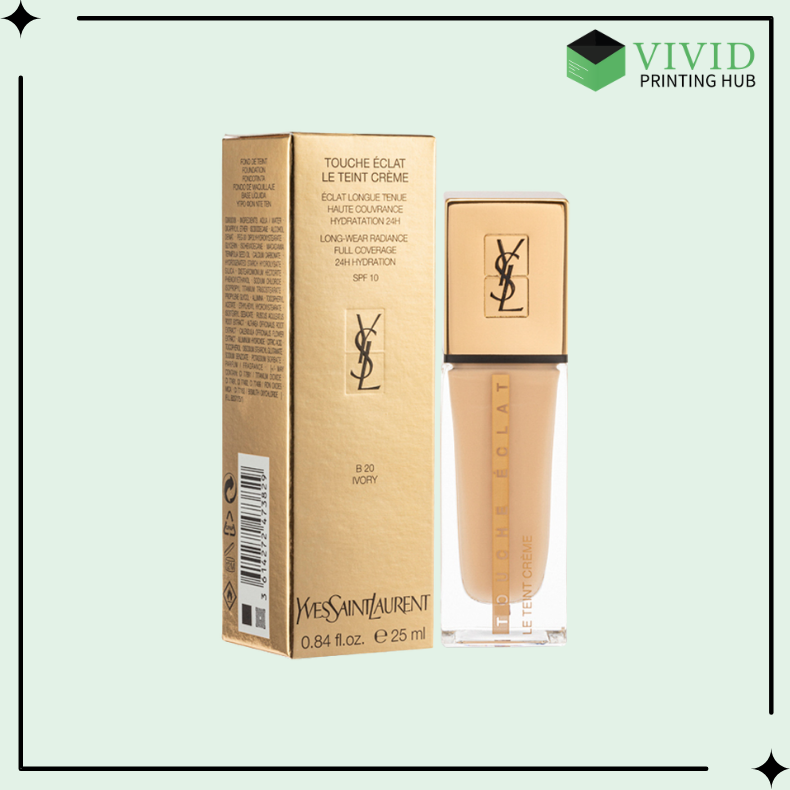


In the world of cosmetics and beauty products, first impressions matter. When your potential customers pick up a foundation box, what do they see? A bland, generic box or a uniquely customized one that reflects your brand’s identity and quality? At Vivid Printing Hub, we understand the importance of packaging in the cosmetics industry, and we’re here to help you make a statement with our custom foundation boxes. In this article, we’ll explore the benefits of choosing Vivid Printing Hub for your custom foundation packaging needs.
Starting From:
$0.80 Original price was: $0.80.$0.30Current price is: $0.30.
Product SKU: vivid-00253567

| Box Style | Custom Made Boxes |
|---|---|
| Dimension (L + W + H) | All Custom Sizes & Shapes |
| Quantities | Minimum 50 Boxes |
| Paper Stock | 52pt to 90pt |
| Printing | CMYK, PMS, No Printing |
| Finishing | Gloss Lamination, Matte Lamination, Gloss AQ, Gloss UV, Matte UV, Spot UV, Embossing, Foiling |
| Included Options | Die Cutting, Gluing, Scored, Perforation |
| Additional Options | Eco-Friendly, Recycled Boxes, Biodegradable |
| Proof | Flat View, 3D Mock-up, Physical Sampling (On request) |
| Turnaround | 15-18 Business Days And Rush Order |
| Shipping | FedEx, DHL, UPS |
The most common foundation packaging complaint has nothing to do with the formula: the consumer presses the pump and nothing comes out. That happens when a box is sized to the bottle body instead of the full assembled height including the pump mechanism — compressing the pump spring throughout shipping and storage until it fatigues.
At Vivid Printing Hub, we manufacture custom foundation boxes across all seven container formats — pump bottles, glass droppers, squeeze tubes, sticks, pressed compacts, cushion compacts, and BB/CC creams — with pump clearance built into every liquid pump order, glass anti-shatter inserts for dropper bottles, PMS shade-matched panels for multi-SKU ranges, and FDA Drug Facts panels designed in from the first brief for any SPF claim.
MOQ: 100 units per shade/SKU. Free complete design service. Free 3D proof. 10–12 business day turnaround. Free US shipping. 100% satisfaction guarantee.
Request Your Free Foundation Box Quote →
| Format | Key Requirement |
|---|---|
| Liquid pump bottle | Box interior must fit the full assembled height (bottle + extended pump) — never the bottle body alone |
| Glass dropper | Fragile, prestige format — two-point collar insert mandatory (base + shoulder) |
| Squeeze tube | Needs 3–5mm lateral clearance per side so the tube can still be squeezed |
| Foundation stick | Tight 1–2mm lateral fit to stop the twist mechanism rotating in transit |
| Pressed compact | Wide-shallow carton; must sit mirror-up, powder-down |
| Cushion compact | Must travel upright (pad down, mirror up) to stop formula migrating to the mirror |
| BB/CC cream (pump or tube) | Same as pump/tube by format — plus a Drug Facts panel if it carries an SPF claim |
| Foundation Format | Container Dimensions | Box Interior | Structure |
|---|---|---|---|
| 30ml pump bottle | 45mm Ø × 135mm total H | 58 × 58 × 150mm | Reverse-tuck |
| 50ml pump bottle | 55mm Ø × 160mm total H | 70 × 70 × 175mm | Reverse-tuck |
| 30ml glass dropper | 35mm Ø × 165mm total H | 52 × 52 × 180mm + insert | Reverse-tuck + die-cut insert |
| 30ml squeeze tube | 30mm Ø × 145mm H | 42 × 42 × 162mm | Reverse-tuck |
| 50ml tinted moisturizer tube | 38mm Ø × 160mm H | 52 × 52 × 178mm | Reverse-tuck |
| Foundation stick | 30mm Ø × 95mm H | 42 × 42 × 110mm | Straight-tuck |
| Pressed compact (80×65mm) | 80 × 65 × 16mm | 93 × 78 × 30mm | Wide-shallow tuck-end |
| Cushion compact 15g | 75mm Ø × 22mm H | 88 × 88 × 36mm | Square shallow tuck-end |
| BB cream pump 30ml | 50mm Ø × 145mm total H | 64 × 64 × 160mm | Reverse-tuck + Drug Facts panel |
| Travel foundation 15ml pump | 35mm Ø × 105mm total H | 48 × 48 × 120mm | Straight or reverse-tuck |
Total height includes the pump at full extension. Send exact container dimensions for a precision confirmation.
A standard pump bottle has three measurable heights: bottle body, internal dip tube, and the pump head extending above the shoulder (typically +30–40mm). Total assembled height = bottle body + pump head. Sizing the box to the bottle body alone compresses the pump head against the closed lid — holding the spring under constant tension through shipping and warehousing until it fatigues.
Our specification: box interior height = total assembled height + 5–8mm headspace. For a 135mm total-height bottle, that’s a 141mm minimum interior — the extra clearance also keeps the lid flap from catching on the pump nozzle during closure.
Window note: if the carton has a front window, keep the pump head fully enclosed above the window opening — an exposed nozzle on a retail shelf is a dust/contamination risk.
Glass dropper bottles ($45–$90+ retail) are the most fragile standard cosmetic container. The fracture-risk zone is the glass shoulder, where lateral rattling during transit concentrates stress.
Two-point collar system (standard on every glass dropper program):
With both collars in place, the bottle has zero lateral movement at the base and shoulder. For DTC shipping, the carton (with inserts) still needs a corrugated outer shipper with at least 25mm of padding on all six faces — the carton alone won’t survive a standard 1.2m drop test.
For brands selling 10–30+ shades, a 15–25mm PMS-matched color strip on the front panel lets the consumer self-select the correct shade without opening the box.
Why PMS, not CMYK: CMYK builds color from four ink variables and can’t reliably hold the subtle distinctions between adjacent skin-tone shades. PMS spot color is pre-mixed to an exact formula, giving reproducible shade accuracy across production runs.
Process: you provide shade references → we match each to the nearest Pantone coated reference → physical proofs are approved against your actual foundation shades → approved PMS specs are kept on file for reorder consistency.
Production: all shades share one dieline — only the shade panel color and name/number change — and run together in a single batch for color-environment consistency. Batch numbers, shade codes, and QR codes can be variably printed per carton at no extra die cost.
Any foundation, BB cream, CC cream, or tinted moisturizer with an SPF claim is regulated as an OTC drug, requiring a Drug Facts panel under 21 CFR Part 201.66:
A full Drug Facts panel for a 30ml foundation needs roughly 40cm² of panel area at minimum type size — this has to be reserved in the carton layout from the first design brief, not added after the brand design is finished. We treat Drug Facts panel placement as the mandatory first step on every SPF foundation and BB/CC cream program.
| Structure | Best For |
|---|---|
| Reverse-Tuck | Pump bottles and glass droppers — stronger base security than straight-tuck |
| Straight-Tuck | Compacts, sticks, and lighter tubes |
| Wide-Shallow Tuck-End | Pressed and cushion compacts |
| Sleeve and Tray | Mid-prestige foundation ($30–$55) |
| Two-Piece Rigid Box | Prestige/luxury foundation ($60+); premium unboxing reveal |
| Auto-Lock Bottom | High-volume mass-market lines needing fast assembly |
| Retail Price | Format | Exterior | Shade System |
|---|---|---|---|
| $8–$18 (mass market) | Tuck-end + peg hole | Gloss UV, CMYK | CMYK shade strip |
| $18–$35 (indie/accessible) | Tuck-end soft-touch | Soft-touch matte, spot UV | PMS shade strip |
| $35–$55 (mid-prestige) | Sleeve and tray or reverse-tuck | Soft-touch matte + foil | PMS shade strip + shade code |
| $55–$85 (prestige) | Two-piece rigid box | Soft-touch matte + gold foil | PMS shade panel + insert |
| $85+ (luxury) | Rigid box or magnetic closure | Specialty paper + deboss/foil | PMS matched + variable data |
FSC-certified SBS or kraft board, water- or soy-based inks (including for shade panels — soy-ink PMS proofs should be approved separately, since the color gamut shifts slightly from conventional inks), aqueous matte coating instead of BOPP film, and die-cut FSC chipboard or molded pulp inserts instead of foam. Documentation available for Sephora Clean, Ulta Conscious Beauty, Target Clean, and Credo Beauty vendor programs. [Confirm current certifications before publishing specific claims.]
| Units per Shade/SKU | Typical Use Case |
|---|---|
| 100 (MOQ) | New launch, single-shade test run |
| 500 | Established brand, single shade or small range |
| 1,000 | Multi-shade range or wholesale fulfillment |
| 2,500+ | Retail distribution, reseller/wholesale pricing |
MOQ: 100 units per shade/SKU. Standard Turnaround: 10–12 business days from artwork approval. Free US Shipping on qualifying orders. Free 3D Proof. 100% Satisfaction Guarantee.
What is the most common sizing mistake for liquid foundation pump bottle boxes? Sizing the box to the bottle body instead of the total assembled height including the pump mechanism. A 30ml pump bottle typically has a 100mm bottle body but a 130–145mm total assembled height — a box sized to 100mm compresses the pump every time the lid is sealed, fatiguing the spring and causing the “dead pump” complaint at first use. We always size to total assembled height plus 5–8mm headspace.
How do I prevent glass dropper foundation bottles from breaking in the box? A die-cut insert is mandatory, not optional. We use a two-point collar system: a base collar holding the bottle base centered, and a shoulder collar at the fracture-risk glass shoulder preventing tipping. For DTC shipping, add a corrugated outer shipper with at least 25mm of foam padding on all six faces.
How should I handle shade-matching for a 20-shade foundation range? All 20 shades share one dieline with individually specified PMS spot color panels — CMYK can’t reliably hold the subtle differences across a large shade range. We match each shade to a Pantone reference, produce physical proofs against your actual foundation for approval, and keep specifications on file for reorder consistency. All shades run together for color-environment consistency.
Does my SPF foundation or BB cream need a Drug Facts panel on the packaging? Yes — any foundation, BB cream, CC cream, or tinted moisturizer with an SPF claim is regulated as an OTC drug and needs a complete Drug Facts panel: active ingredients, purpose, uses, warnings, directions, and inactive ingredients. This is planned into the initial design brief, not added afterward.
What box size do I need for my foundation pump bottle? Provide your bottle’s diameter and total assembled height (bottle + fully extended pump). As a reference: a 30ml pump at 45mm Ø with a 140mm total height needs roughly a 58 × 58 × 155mm interior; a 50ml pump at 55mm Ø with a 165mm total height needs roughly 70 × 70 × 180mm.
What carton format is best for a cushion compact foundation? A wide-shallow square or circular tuck-end carton, traveling upright (mesh pad down, mirror up) to stop the formula migrating to the mirror. We add “This Side Up” markings on outer shippers for DTC cushion compact programs, with 2–3mm lateral clearance to prevent tipping in transit.
What is the minimum order for custom foundation boxes? 100 units per shade/SKU. A 10-shade launch is 1,000 total units minimum. Volume pricing improves at 500, 1,000, and 2,500+ units per shade, with all shades produced together as one run.
What is your turnaround time? 10–12 business days from artwork approval, with rush production available on request.
Do you offer design assistance? Yes — free complete design service, including 3D mockups and repeated digital proofs before production.
Do you offer samples? Yes — random sample kits and custom physical prototypes are available before bulk production; samples may be offered free depending on order size.
Foundation is a repeat, high-loyalty purchase — and the packaging decision made once at launch shapes every customer’s experience of your formula after that. A compressed pump, a shattered dropper bottle, or a mismatched shade strip are none of them recoverable. At Vivid Printing Hub, we build against all three from the first proof.
Call: +1 (786) 619-8471 Email: sales@vividprintinghub.com
Request Your Free Foundation Box Quote → Format Confirmation · Pump Clearance Spec · Shade Panel Matching · FDA Compliance Review · Same-Day Response
Our MOQ varies depending on the product type and customization requirements. We can start with as few as 5 or 50 boxes and scale up to thousands, with pricing adjusting accordingly. For specific details on your product, feel free to reach out—we’re happy to assist with orders of all sizes!
Our delivery timeline ranges from 5 to 20 business days, depending on order quantity and customization requirements. We offer both standard turnaround and rush services for faster delivery. Contact us to discuss the best option for your needs!
Yes! We provide Random Sample Kits as well as Custom Physical Prototypes of your box before bulk production for approval. Depending on the order quantity, samples may be offered free of charge. You can also order a standalone prototype if needed. Contact us to learn more!
Absolutely! Our professional designers are here to help craft the perfect design for your custom packaging—free of charge. Whether you have a rough sketch, an idea, or need a complete box template, we’ll work closely with you to bring your vision to life. We also provide 3D mockups and repeated digital proofs to ensure everything aligns perfectly with your brand and product needs before production.
The ideal box size depends on your product’s dimensions, weight, and protection requirements. Simply provide the exact length, width, and height, and we’ll handle the rest! Alternatively, you can share a product link or CAD drawing for precise customization. If you’re unsure, our experts are here to help with tailored recommendations, 3D mockups, and digital proofs to ensure a perfect fit.
The cost of a custom box depends on several factors:
Color Printing: Printing 1-2 colors or full-color on the outside doesn’t impact cost significantly, but inside printing adds to the price.
Box Structure: Flat-shipped boxes are more cost-effective, while pre-assembled boxes are pricier due to volume and shipping considerations.
Customization & Materials: Specialty finishes, coatings, and high-end materials also influence pricing.
For a precise quote, feel free to reach out!
Yes! Our pricing is volume-based, meaning larger orders come with better price breaks. The more you order, the lower the cost per unit. If you’re considering a bulk purchase, reach out to our team for a customized quote!
Yes! We provide exclusive reseller pricing for businesses ordering in bulk or frequently. If you’re a reseller, distributor, or packaging supplier, contact us to discuss custom pricing, discounts, and partnership opportunities tailored to your needs.
Sam Carter
Sales Manager
Hi there! I’m looking for custom packaging boxes. Can you help me out?