
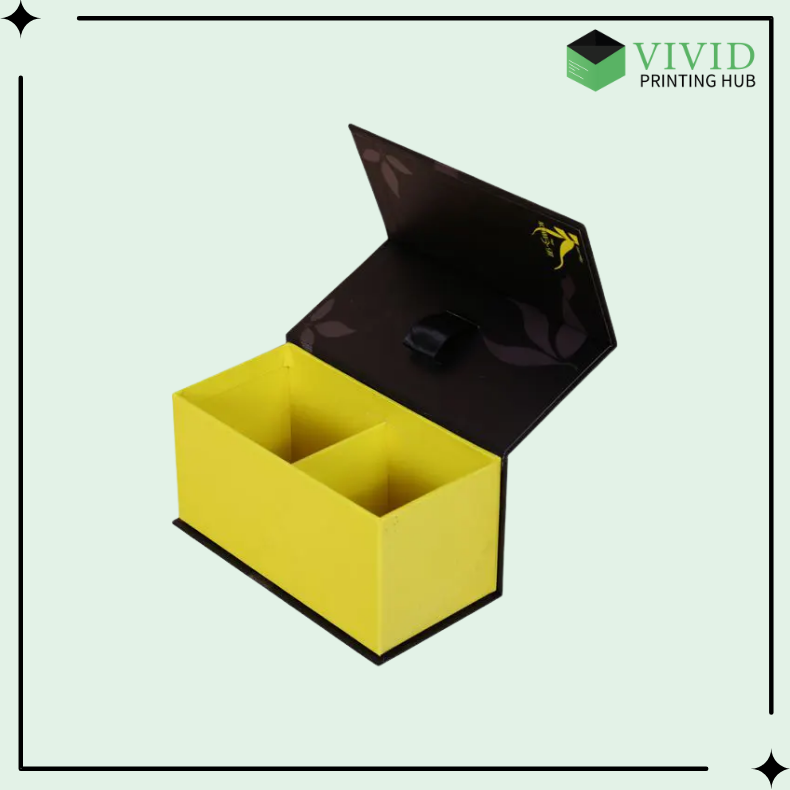
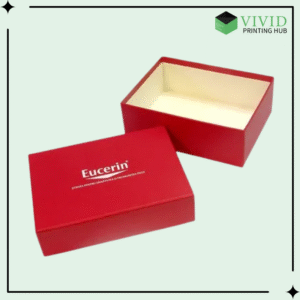
In the dynamic world of business, standing out from the crowd is essential. One way to achieve this is through impeccable packaging that not only safeguards your products but also communicates your brand’s identity. Vivid Printing Hub is here to help you achieve just that with our Custom Hinged Lid Boxes.
Starting From:
$5.00 Original price was: $5.00.$3.50Current price is: $3.50.
Product SKU: vivid-0098

| Box Style | Custom Made Boxes |
|---|---|
| Dimension (L + W + H) | All Custom Sizes & Shapes |
| Quantities | Minimum 50 Boxes |
| Paper Stock | 52pt to 90pt |
| Printing | CMYK, PMS, No Printing |
| Finishing | Gloss Lamination, Matte Lamination, Gloss AQ, Gloss UV, Matte UV, Spot UV, Embossing, Foiling |
| Included Options | Die Cutting, Gluing, Scored, Perforation |
| Additional Options | Eco-Friendly, Recycled Boxes, Biodegradable |
| Proof | Flat View, 3D Mock-up, Physical Sampling (On request) |
| Turnaround | 15-18 Business Days And Rush Order |
| Shipping | FedEx, DHL, UPS |
Pick up two hinged lid boxes from different suppliers. They might look identical in a product photo. Open one — the lid lifts smoothly, catches at 135 degrees, and holds its position without falling back. The magnet closes with a precise, satisfying resistance. The hinge shows no sign of stress after hundreds of open cycles.
Open the other — the lid falls backward past 90 degrees before you can remove the product. The magnet snaps shut with a jarring force. After ten open cycles, the hinge chipboard shows a stress crack at the score line.
Same appearance. Completely different engineering. The difference is in the hinge construction method, the lid opening angle, the magnet grade, and the retention mechanism — four engineering variables that zero competitors explain, and that determine whether your packaging communicates premium quality or only suggests it.
At Vivid Printing Hub, we engineer custom hinged lid boxes from the hinge mechanics outward — with fabric tape hinge construction for high-cycle durability, controlled lid opening angles with stay mechanisms where required, precisely graded magnetic closure, and shoulder-neck internal architecture for premium fit and feel.
MOQ from 100 units. Free complete design service. Free 3D proof before production. 10–12 business day turnaround. 100% satisfaction guarantee.
Request your free quote today — same-day response.
The hinge is the most mechanically stressed component of any hinged lid box. Every open and close cycle loads the hinge in tension and bending — and the construction method determines how many cycles the hinge withstands before showing fatigue.
The base and lid are cut from a single chipboard sheet spanning the back panel of both components, with a precision score line at the connecting point. The box opens and closes along this score line.
Advantages: Simple construction, lowest manufacturing cost, adequate for low-frequency-use applications.
Limitation: Chipboard fatigues at the score line under repeated flexing. A scored chipboard hinge showing stress cracking is one of the most common quality failures in mid-range hinged lid boxes — typically appearing after 50–200 open/close cycles depending on chipboard grade and wall thickness. Acceptable for single-use gifting or low-frequency retail display but not recommended for products that will be opened and closed repeatedly.
Best for: Single-use gifting applications, low-frequency retail display, budget-tier hinged lid boxes.
A strip of book-binding cloth, linen tape, or woven fabric ribbon is bonded across the exterior back join of the base and lid panels — spanning the hinge point and distributing flex stress across the fabric’s fiber structure rather than concentrating it at a single score line.
Advantages: Withstands thousands of open/close cycles without cracking or delaminating. The fabric maintains its structural integrity under repeated flexing because woven fibers absorb bending stress through fiber-to-fiber movement rather than through material fracture. Produces a cleaner, more refined hinge exterior appearance — the fabric tape is often visible as a design feature in premium packaging.
Best for: Products that will be opened and closed repeatedly — jewelry storage boxes, keepsake boxes, display boxes, watch boxes, any application where the consumer will keep and reuse the box.
A wide satin or grosgrain ribbon, bonded along the full interior spine of the box, acts as both the hinge mechanism and an interior decorative element. The ribbon’s width distributes flex stress across the full hinge length rather than at a single point. The interior ribbon also acts as a soft lid cushion when the box is closed.
Advantages: Maximum hinge durability, interior decorative function, premium tactile experience, the signature construction of ultra-luxury hinged box formats (haute jewelry, luxury watches, premium fragrance).
Best for: Ultra-premium gifting, luxury brand flagship packaging, keepsake and collectible boxes, any application where the interior hinge will be visible and experienced by the consumer.
The maximum opening angle of a hinged lid box and the mechanism that holds it at that angle are functional engineering decisions — not aesthetic ones. Getting these wrong creates a poor user experience regardless of the exterior finish quality.
The lid rises to perpendicular with the base and is held in position by the hinge tension. The most compact format — appropriate when the box will be opened briefly for product access and immediately resealed. The 90-degree open position requires no stay mechanism when hinge tension is calibrated correctly to the lid weight.
Best for: Compact product storage, regular-use boxes where full lid extension is not required, space-efficient retail display.
The lid opens past perpendicular to a comfortable resting angle — the most ergonomically natural position for product inspection and access. The lid weight at this angle requires either a calibrated hinge tension or a fabric ribbon stay to prevent fall-back.
Best for: Jewelry display, cosmetic sets, product gifting where the consumer needs comfortable access to inspect or select items.
The lid opens fully flat, extending the box’s footprint and creating a display surface. The 180-degree open position is the standard for luxury retail display — the open box presents the product face-up with the lid acting as a branded backdrop or logo display surface behind the product.
Stay mechanism required: Without a stay mechanism, a 180-degree lid falls flat under gravity and may damage the hinge under its own weight. The standard stay for 180-degree hinged boxes is a fabric ribbon loop connecting the interior of the base side wall to the interior of the lid side wall — catching the lid at exactly 180 degrees and distributing the lid weight across the ribbon rather than the hinge.
Best for: Jewelry counter display, watch retail display, luxury cosmetics launch events, premium retail shelf presentation.
“Hinged lid boxes” is searched by two distinct buyer types — and the product they need is fundamentally different.
Constructed from thick chipboard (2mm–3mm) wrapped in decorative paper. Does not fold flat — ships assembled. Heavy, structurally permanent walls. Premium weight feel. The consumer experiences the box as a durable, reusable object.
Applications: Jewelry, watches, luxury cosmetics, premium gifting, corporate gifting, keepsake boxes, retail display. Price point: Higher unit cost reflecting chipboard, labor-intensive assembly, and wrap paper. Shipping: Significant cube; ships assembled; requires outer corrugated shipper for DTC.
Constructed from cardboard stock (14pt–28pt SBS or CUK). Folds flat for storage and shipping — the consumer assembles or opens flat. Lighter weight. Less permanent structure.
Applications: Food packaging (chocolates, confectionery, bakery items), mid-range retail products, pharmaceutical, consumer goods. Price point: Significantly lower unit cost; ships flat; no outer shipper required. Shipping: Ships flat; high density packing efficiency.
Which do you need? If your product is a premium consumer item requiring a permanent, reusable box that communicates luxury — rigid chipboard. If your product is food, retail goods, or any application requiring flat-pack efficiency — folding carton. We produce both. Contact us with your product details and we advise on the optimal construction for your specific application and budget.
Magnetic closure is the most-requested feature in premium hinged lid boxes — and one of the most frequently under-specified. The magnet grade, size, and placement determine whether the closure feels premium or cheap.
Magnets are graded by their pull strength — N35 (standard), N38, N42, N50 (strongest standard grade). Higher N-grade magnets provide stronger pull force in smaller sizes.
Placement standard: Magnet centered at 15mm–20mm from the lid front edge — close enough to the front for easy thumb-and-finger grip when opening, far enough from the edge to prevent chipboard delamination from magnet pull stress.
We specify magnet grade and placement for every hinged lid box based on the lid dimensions, wall thickness, and total assembled box weight — ensuring correct closure retention without over- or under-specifying.
Premium hinged lid rigid boxes are produced in two internal architectures that significantly affect the quality feel of the lid closure.
The lid closes directly over the exterior of the base — the lid exterior walls overlap the base exterior walls when closed. The lid can shift laterally by the amount of the lid-to-base clearance.
Characteristic: Slight lateral lid movement when closed is normal. Acceptable for standard applications.
An inner shoulder or neck structure — a secondary layer of chipboard inside the base walls — creates a raised platform that the lid fits over when closed. The shoulder provides a precision-locating surface that eliminates lateral lid movement and creates a positive, click-in fit feel.
Characteristic: The lid drops onto the shoulder with a precise, located fit — no lateral movement. Produces the premium closure quality associated with luxury watch and jewelry boxes. Additional material and labor — reflected in higher unit cost. Recommended for ultra-premium products and any application where closure quality is a primary brand communication.
Velvet Flocking — Electrostatic velvet fiber coating on interior base and lid. Standard for jewelry, watches, and ultra-premium cosmetic hinged lid boxes. Available in black, navy, ivory, cream, sage, and custom brand colors.
Foam Cavity Insert — Die-cut closed-cell EVA foam. Standard for electronics, fragrance, and any product requiring full surface protection and movement prevention.
Satin Lining — Fabric interior lining of base and lid walls. Ultra-premium finish — used in luxury perfume, jewelry keepsakes, and wedding gifting.
Ribbon Spine Interior — Decorative ribbon along the hinge spine doubles as the hinge mechanism and an interior visual element. Standard in ultra-premium ribbon-hinge construction.
Food-Safe Paper Lining — Uncoated kraft or food-contact-certified coated paper for confectionery, chocolate, gourmet food, and bakery hinged lid box applications. We use food-safe adhesives throughout.
Printed Interior — Full-color CMYK printing on the interior base, lid interior, and interior walls — brand pattern, product story, care instructions, or occasion-specific messaging.
Hinged lid boxes are one of the most popular premium food gifting formats — chocolates, artisan confectionery, gourmet cookies, macarons, tea, coffee, wedding favor candy, and charcuterie all use hinged lid boxes for premium retail and gifting presentation.
Food applications require specific construction specifications:
Food-safe interior lining — Uncoated kraft paper or food-contact-certified coated paper lining. No print chemicals on any surface that contacts food directly.
Food-safe adhesives — All glue-up adhesives used in food-contact hinged lid boxes must be food-safe (non-solvent-based, FDA food contact material compliant). We confirm adhesive specifications for food-contact applications before production.
Segregated exterior/interior printing — Exterior surfaces may use standard offset printing with gloss or matte lamination. Interior surfaces are food-safe lined — print applied to exterior surfaces only, with the food-safe liner creating a complete barrier between print chemistry and food product.
Venting considerations — Fresh food applications (artisan chocolates, pastries) may require micro-perforation venting in the lid to prevent moisture accumulation. We design venting into the lid construction for applicable food formats.
Hinged lid boxes have one of the highest consumer keep-rates of any packaging format. Unlike tuck boxes, sleeve packaging, or corrugated mailers — which the majority of consumers discard within days of receipt — rigid hinged lid boxes are retained and reused because they have immediate utility as storage boxes, keepsake containers, desk organizers, and display items.
Industry packaging research consistently shows consumer retention rates of 60–85% beyond 6 months for premium rigid hinged boxes. A consumer who keeps your hinged lid box on their desk, dresser, or jewelry stand sees your brand logo multiple times per day — brand impressions delivered at zero additional cost, for months or years after the original purchase.
This post-purchase brand presence is the key ROI argument for investing in premium hinged lid boxes over less expensive single-use packaging formats. The per-impression cost of a hinged lid box — calculated across its full retention period — is among the lowest of any brand touchpoint in the consumer journey.
The original hinged lid box application — and still the dominant format for fine jewelry and watch presentation. Shoulder-neck construction for precision fit, velvet flocking interior, ribbon spine hinge for durability, 135-degree or 180-degree opening for display. Available from ring box (40mm × 40mm footprint) to bracelet box, necklace box, and watch box formats.
Perfume, skincare sets, and luxury cosmetics gift sets. Tall formats for single perfume bottles; wide shallow formats for multi-product sets. Foam cavity or velvet interior; fabric tape hinge; soft-touch matte lamination with foil embossed brand mark.
Chocolates, macarons, artisan confectionery, gourmet cookies, tea/coffee gift sets. Food-safe interior lining with food-contact adhesives. Ribbon hinge or scored chipboard hinge (single-use gifting). Sizes from 4-piece chocolate box to large assortment formats.
Custom branded hinged lid boxes with corporate color system, foil-embossed logo, foam or velvet interior for multi-product gift configurations, ribbon stay at 135-degree angle. Volumes 200–50,000 units. Personalized insert card slot standard.
Earbuds, smartwatches, premium cables, tech gift sets. Foam cavity insert matched to product contours. Chipboard grade: 2.5mm–3mm for product weight support. Soft-touch or gloss UV finish for tech brand aesthetic.
Keepsake boxes, wedding favor boxes, anniversary gifts. Ribbon spine hinge for maximum durability. Satin or velvet interior. Foil-embossed monogram or occasion messaging. 180-degree display format for table place settings.
Full-Color CMYK Offset — Standard for custom brand printing across all exterior surfaces. PMS Spot Color — Brand-critical color accuracy for corporate and luxury brand programs. Soft-Touch Matte Lamination — The dominant premium finish for jewelry, cosmetics, and gifting hinged lid boxes. Warm, velvety, fingerprint-resistant. High-Gloss UV Lamination — Vibrant finish for food gifting, tech, and retail channel applications. Spot UV — Selective gloss over matte base for logo and design element emphasis. Gold / Silver / Rose Gold Foil Stamping — Standard premium finish for luxury brand marks. Embossing / Debossing — Dimensional brand treatment. Debossing on the lid top is the restrained luxury standard. Leatherette and Suede Wrap — Textured exterior wrap for luxury jewelry and premium gifting positioning.
MOQ: 100 units. Standard Turnaround: 10–12 business days from artwork approval. Rush Production: Available for launch deadlines and seasonal programs. Volume Tiers: 100 / 500 / 1,000 / 2,500+ units. Free US Shipping on qualifying orders. Free 3D Digital Proof before production. 100% Satisfaction Guarantee.
Hinge Construction Expertise — Scored chipboard, fabric tape, ribbon spine — we specify the right hinge method for your product’s open-cycle frequency and premium positioning requirements.
Lid Angle and Stay Engineering — We engineer your lid opening angle (90°, 135°, 180°) and specify the appropriate stay mechanism — fabric ribbon loop, magnetic pad, or hinged prop — for your product display format.
Magnetic Closure Grading — We specify magnet grade (N35–N50) and placement based on your lid dimensions and box weight — ensuring the right closure force, not just “magnetic closure.”
Shoulder-Neck Construction Option — For ultra-premium positioning, shoulder-neck inset lid architecture producing precision-located, lateral-movement-free lid closure.
Food-Safe Construction — Food-contact-certified interior lining, food-safe adhesives, confirmed for confectionery, chocolate, bakery, and gourmet food applications.
Free Complete Design Service — All exterior panels, interior finishing, ribbon stay specification, insert design — zero additional cost.
Free 3D Digital Proof — Approve every exterior surface and interior configuration in photorealistic 3D.
10–12 Day Standard Turnaround.
100% Satisfaction Guarantee.
Step 1 — Share Your Product Details Tell us: product dimensions and weight, desired construction (rigid chipboard or folding carton), hinge type preference, opening angle, magnetic closure requirement, interior finish, and volume. Same-day quote.
Step 2 — Engineering and Design Review Our team specifies hinge construction, opening angle, magnet grade and placement, stay mechanism, and interior finish. Complete exterior artwork created. All revisions free.
Step 3 — Approve Your 3D Proof Review every exterior panel and interior in photorealistic 3D. All revisions free.
Step 4 — Production and Delivery Ships in 10–12 business days from artwork approval.
Call us: +1 (786) 619-8471 Email us: sales@vividprintinghub.com
What is the difference between a scored chipboard hinge and a fabric tape hinge? A scored chipboard hinge uses a single chipboard sheet with a precision score line at the lid-base connection — the box opens along this score. It is the standard construction for mid-range hinged lid boxes and is adequate for low-frequency use (gifting, single-use retail). However, the chipboard fatigues at the score line under repeated flexing — stress cracking typically appears after 50–200 open cycles depending on chipboard grade. A fabric tape hinge bonds a strip of woven linen or book-binding cloth across the exterior hinge join — distributing flex stress across the fabric fiber structure rather than concentrating it at a single score line. Fabric tape hinges withstand thousands of open cycles without cracking. We recommend fabric tape construction for any box that will be used regularly by the consumer.
What lid opening angle should I specify for my hinged lid box? The optimal opening angle depends on your primary use case. For brief product access and immediate resealing (daily-use jewelry box, keepsake storage), 90–110 degrees is appropriate and requires no stay mechanism. For comfortable product inspection and access (gift opening, cosmetic sets, corporate gifting), 135 degrees provides the most ergonomic open position — a fabric ribbon stay is recommended to prevent lid fall-back. For retail counter display (jewelry, watches, luxury cosmetics), 180 degrees is standard — the lid lies flat, creating a display backdrop behind the product. A fabric ribbon stay is required at 180 degrees to prevent lid damage from weight. Tell us your intended use case and we specify the correct angle.
What magnet grade should I use for my hinged lid box? Magnet selection depends on your lid weight and desired closure feel. For standard lightweight rigid hinged boxes (single-layer chipboard lid, no foam insert, total assembled weight under 200g), N38 grade button magnets provide the correct balance of closure retention and opening ease — a satisfying resistance without excessive force. For heavier lids (thick chipboard, velvet or foam interior, total weight 300g+), N42 grade prevents accidental lid opening during handling. We specify grade, size, and placement for every order based on your box specifications — magnet under-specification and over-specification are both quality failures we engineer out before production.
What is the difference between standard hinged construction and shoulder-neck construction? Standard hinged construction has the lid closing directly over the base exterior — some lateral lid movement is normal and expected. Shoulder-neck (inset lid) construction adds a raised chipboard shoulder or neck inside the base walls that the lid closes over, providing a precision-locating surface that eliminates lateral movement. The lid drops onto the shoulder with a positive, located fit — the closure feels engineered rather than approximate. Shoulder-neck construction adds material and labor cost — typically 15–25% above standard construction — and is recommended for ultra-premium products where closure quality is a primary brand communication.
Can hinged lid boxes be used for food products like chocolates? Yes — hinged lid boxes are widely used for premium food gifting. Food applications require specific construction: food-safe interior lining (uncoated kraft or food-contact-certified coated paper on all surfaces that contact food), food-safe adhesives throughout the box assembly (no solvent-based adhesives), and exterior printing applied only to exterior surfaces with the food-safe interior liner creating a complete barrier. We produce food-safe hinged lid boxes for chocolates, confectionery, macarons, artisan cookies, gourmet food gifts, and wedding favor candy. We confirm food-contact compliance specifications for your specific product and market before production.
What is the minimum order for hinged lid boxes? Our minimum order is 100 units — appropriate for product launches, limited editions, corporate gifting programs, and seasonal programs. Volume pricing improves at 500, 1,000, and 2,500+ units. Shoulder-neck construction and ribbon spine hinges are most cost-effective at 500+ units.
What interior finishes are available for hinged lid boxes? Options include: velvet flocking (jewelry and watch standard), foam cavity insert (electronics and fragrance), satin lining (ultra-luxury — perfume and wedding gifts), ribbon spine interior (visible hinge ribbon as decorative element), food-safe kraft paper lining (confectionery and food gifting), and full-color interior printing (brand story, product care instructions, occasion messaging). We advise on the right interior finish for your product type, price point, and consumer use case.
What is the difference between a rigid chipboard hinged lid box and a folding carton hinged lid box? A rigid chipboard hinged lid box uses 2mm–3mm thick chipboard wrapped in decorative paper — ships assembled, does not fold flat, heavy and structurally permanent, premium weight feel. Used for jewelry, watches, luxury cosmetics, and corporate gifting. A folding carton hinged lid box uses 14pt–28pt cardboard stock — ships flat, consumer assembles, lighter weight, lower cost. Used for food packaging, mid-range retail, pharmaceutical, and any application requiring flat-pack shipping efficiency. The right choice depends on your product, price point, and channel. We produce both and advise on the optimal construction for your specific requirements.
How long does production take for hinged lid boxes? Standard production is 10–12 business days from artwork approval. Rush production is available for launch deadlines. For multi-size or multi-finish programs, all variants are produced simultaneously — turnaround remains 10–12 business days from final artwork approval across all SKUs.
The hinge is not a detail. It is the moment your customer first experiences your packaging — and every subsequent time they open and close the box. A fabric tape hinge that withstands years of daily use. A lid that holds at exactly 135 degrees without falling. A magnetic closure that releases with calibrated resistance. These are the engineering decisions that separate packaging that looks premium from packaging that IS premium.
At Vivid Printing Hub, we engineer hinged lid boxes from the hinge mechanics outward — specifying construction method, opening angle, magnet grade, and interior finish for your specific product, use case, and brand positioning.
Call us: +1 (786) 619-8471 Email us: sales@vividprintinghub.com
Request Your Free Hinged Lid Box Quote — Same-Day Response, Free Complete Design, Free 3D Proof, Hinge Engineering Consultation Included
Our MOQ varies depending on the product type and customization requirements. We can start with as few as 5 or 50 boxes and scale up to thousands, with pricing adjusting accordingly. For specific details on your product, feel free to reach out—we’re happy to assist with orders of all sizes!
Our delivery timeline ranges from 5 to 20 business days, depending on order quantity and customization requirements. We offer both standard turnaround and rush services for faster delivery. Contact us to discuss the best option for your needs!
Yes! We provide Random Sample Kits as well as Custom Physical Prototypes of your box before bulk production for approval. Depending on the order quantity, samples may be offered free of charge. You can also order a standalone prototype if needed. Contact us to learn more!
Absolutely! Our professional designers are here to help craft the perfect design for your custom packaging—free of charge. Whether you have a rough sketch, an idea, or need a complete box template, we’ll work closely with you to bring your vision to life. We also provide 3D mockups and repeated digital proofs to ensure everything aligns perfectly with your brand and product needs before production.
The ideal box size depends on your product’s dimensions, weight, and protection requirements. Simply provide the exact length, width, and height, and we’ll handle the rest! Alternatively, you can share a product link or CAD drawing for precise customization. If you’re unsure, our experts are here to help with tailored recommendations, 3D mockups, and digital proofs to ensure a perfect fit.
The cost of a custom box depends on several factors:
Color Printing: Printing 1-2 colors or full-color on the outside doesn’t impact cost significantly, but inside printing adds to the price.
Box Structure: Flat-shipped boxes are more cost-effective, while pre-assembled boxes are pricier due to volume and shipping considerations.
Customization & Materials: Specialty finishes, coatings, and high-end materials also influence pricing.
For a precise quote, feel free to reach out!
Yes! Our pricing is volume-based, meaning larger orders come with better price breaks. The more you order, the lower the cost per unit. If you’re considering a bulk purchase, reach out to our team for a customized quote!
Yes! We provide exclusive reseller pricing for businesses ordering in bulk or frequently. If you’re a reseller, distributor, or packaging supplier, contact us to discuss custom pricing, discounts, and partnership opportunities tailored to your needs.
Sam Carter
Sales Manager
Hi there! I’m looking for custom packaging boxes. Can you help me out?