
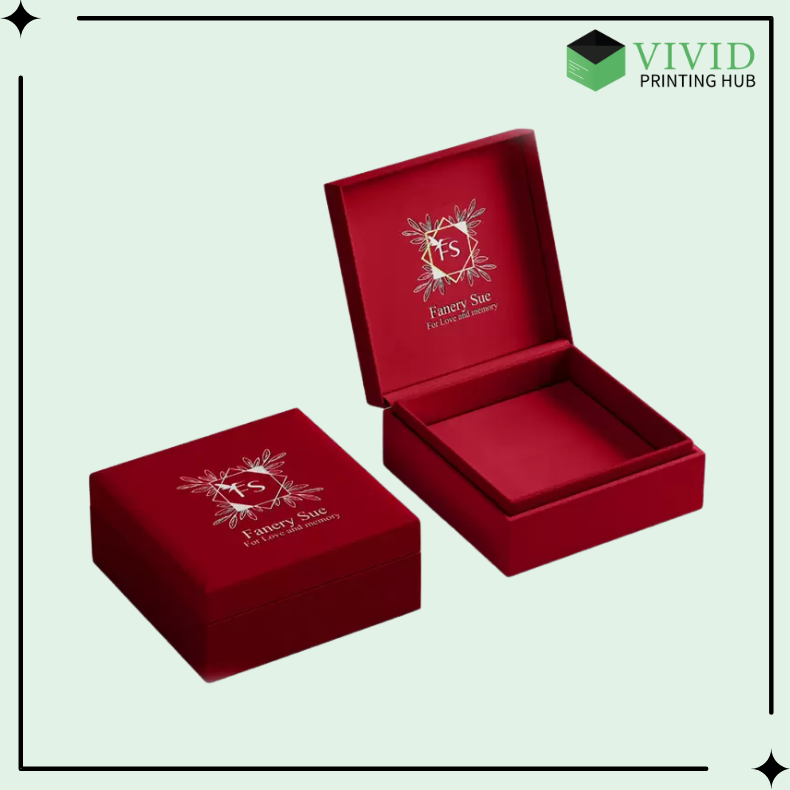


In the world of jewelry, presentation matters. The way you package and showcase your exquisite jewelry pieces can leave a lasting impression on your customers. Vivid Printing Hub understands the importance of making a statement with your jewelry packaging, which is why we offer a wide range of custom jewelry boxes that are not only stylish but also functional. In this article, we’ll delve into the world of custom jewelry boxes and how Vivid Printing Hub can help you elevate your brand with these essential accessories.
Starting From:
$0.80 Original price was: $0.80.$0.30Current price is: $0.30.
Product SKU: vivid-00254445

| Box Style | Custom Made Boxes |
|---|---|
| Dimension (L + W + H) | All Custom Sizes & Shapes |
| Quantities | Minimum 50 Boxes |
| Paper Stock | 52pt to 90pt |
| Printing | CMYK, PMS, No Printing |
| Finishing | Gloss Lamination, Matte Lamination, Gloss AQ, Gloss UV, Matte UV, Spot UV, Embossing, Foiling |
| Included Options | Die Cutting, Gluing, Scored, Perforation |
| Additional Options | Eco-Friendly, Recycled Boxes, Biodegradable |
| Proof | Flat View, 3D Mock-up, Physical Sampling (On request) |
| Turnaround | 15-18 Business Days And Rush Order |
| Shipping | FedEx, DHL, UPS |
A fine jewelry brand’s reputation is not made by the ring alone. It is made by the complete experience: the box that holds the ring at a precise height above the velvet, the lid that opens to the correct angle for the reveal, the velvet that provides a deep-contrast backdrop that makes the diamond appear to radiate from within the dark surface.
And it is damaged — sometimes permanently — by the packaging that was supposed to protect the piece: the foam insert outgassing trace sulfur compounds that tarnish the sterling silver band before the consumer opens the box; the cotton-filled interior that creates micro-abrasion on the rhodium plating of a white gold setting; the ring slot sized slightly too wide so the ring tips sideways and the diamond faces away from the consumer at the moment of reveal.
At Vivid Printing Hub, we manufacture custom jewelry boxes with interior materials specified for your jewelry metal type, dimensions confirmed to your specific jewelry piece, velvet fiber length selected for your piece’s visual display requirements, and anti-tarnish treatments available for sterling silver and copper-alloy programs.
MOQ from 100 units. Free complete design service. Free 3D proof before production. 10–12 business day turnaround. Free US shipping. 100% satisfaction guarantee.
Request your free quote today — same-day response.
There is no such thing as a standard “jewelry box.” There are 12 distinct jewelry item formats — each requiring different interior dimensions, different insert configurations, and different structural engineering.
| Jewelry Type | Jewelry Dimensions | Box Interior | Insert Type | Format Notes |
|---|---|---|---|---|
| Solitaire ring | 18–22mm Ø × 6–8mm band H | 55mm × 55mm × 45mm | Ring cushion slot, 20–22mm Ø | Slot must grip ring band firmly |
| Engagement ring (halo/statement) | 22–30mm Ø × 8–12mm H | 65mm × 65mm × 48mm | Deep velvet slot, 28–32mm Ø | Lid angle: 90–120° for reveal |
| Stud earrings (pair) | 5–15mm × 5–15mm each | 70mm × 70mm × 28mm | Velvet flat pad with 2 stud holes | Short pile velvet, 1.5mm |
| Drop/dangle earrings (pair) | 8–35mm wide × 30–80mm H | 75mm × 75mm × 45mm | Velvet platform with wire slots | Deeper box for wire hooks |
| Pendant (small, 15–25mm) | 15–25mm × 15–25mm | 70mm × 70mm × 38mm | Velvet pad with necklace tuck | Card-slot for chain |
| Pendant + chain (18″ necklace) | Pendant 25mm, chain 18″ | 90mm × 90mm × 42mm | Neck form or wrapped insert | Chain must not tangle |
| Long necklace (24″–30″) | 24″–30″ chain length | 160mm × 120mm × 35mm | Wide-shallow velvet base | Chain laid flat or figure-8 |
| Chain bracelet (7″) | 7″ length, 5–8mm width | 105mm × 55mm × 32mm | Velvet bracelet rail | Coiled or straight layout |
| Bangle/rigid bracelet | 60–70mm Ø × 8–12mm | 90mm × 90mm × 40mm | Velvet ring form (bangle size) | Must clear bangle Ø + 5mm |
| Watch (40mm case) | 40–48mm Ø case, crown +3mm | 110mm × 95mm × 68mm | Watch cushion with crown clearance | Crown must not be compressed |
| Ring + earring set | Ring + stud pair | 125mm × 55mm × 48mm | Dual-compartment: ring slot + earring pad | Coordinated reveal layout |
| Necklace + earring set | Pendant + stud pair | 130mm × 90mm × 45mm | Side-by-side: necklace + earring zones | Most common gift set format |
All measurements are box interior dimensions. Jewelry dimensions vary — provide exact piece measurements for precision confirmation.
Fine silver, sterling silver, and copper-alloy jewelry tarnishes through chemical reaction with sulfur-containing gases — primarily hydrogen sulfide (H₂S) and sulfur dioxide (SO₂) — that are present in ambient air and in certain packaging materials.
The jewelry box interior is either a tarnish-prevention asset or a tarnish-accelerating liability.
Standard rubber elements: Rubber bands, rubber gaskets, and rubber-backed adhesives used in box assembly all contain sulfur compounds that outgas in enclosed box conditions. We specify no rubber-based adhesives or components in any sterling silver jewelry box program.
Untreated polyurethane foam: Standard PU foam used in many insert systems can contain sulfur-based catalysts from its manufacturing process. Over time in a sealed box, these compounds create a micro-environment of reactive gases in contact with the silver surface. We specify anti-tarnish treated foam for all silver jewelry box programs.
Certain synthetic dye chemistry: Some synthetic velvet dyes contain sulfur compounds that can accelerate tarnish in the immediate vicinity of the fabric surface. Anti-tarnish velvet (treated with Pacific Silvercloth-grade anti-tarnish chemistry) neutralizes these compounds.
Cardboard and paper in contact with silver: Acidic cardboard (non-acid-free) can promote oxidation. All interior paper elements for silver jewelry programs should be acid-free.
Anti-tarnish treated velvet: The standard for fine sterling silver jewelry boxes. The velvet fabric is treated with an anti-tarnish agent that actively absorbs and neutralizes H₂S and SO₂ in the enclosed box interior. Pacific Silvercloth is the recognized standard for anti-tarnish textile treatment. Anti-tarnish velvet is available in all standard jewelry box colors.
Anti-tarnish paper strip: A small strip of anti-tarnish treated paper (typically 20mm × 50mm) placed in the box interior — absorbs reactive sulfur gases from the ambient environment inside the sealed box. The most cost-effective anti-tarnish protection for programs where anti-tarnish velvet is not specified.
Anti-tarnish treated foam: Foam substrate manufactured with anti-tarnish agent incorporated — neutralizes reactive gases generated by the foam itself and from the box environment.
Natural cotton (untreated): Natural fiber with minimal sulfur outgassing — relatively benign for silver compared to untreated synthetic materials. Not actively anti-tarnish but does not accelerate tarnishing under normal retail storage conditions.
| Jewelry Metal | Tarnish Risk | Recommended Interior | Avoid |
|---|---|---|---|
| Fine silver (.999) | Very High | Anti-tarnish velvet + foam | Standard rubber, standard PU foam |
| Sterling silver (.925) | High | Anti-tarnish velvet or anti-tarnish strip | Standard rubber, untreated PU foam |
| Silver-plate fashion | Moderate | Anti-tarnish velvet or cotton-filled | Standard rubber adhesives |
| Yellow gold (14K/18K) | Low | Standard velvet (any color) | Abrasive interiors |
| White gold (rhodium-plated) | Low (plating abrasion concern) | Smooth velvet (2.0mm standard) | Cotton-filled (micro-abrasion on rhodium) |
| Rose gold (copper alloy) | Moderate | Anti-tarnish velvet | Standard rubber |
| Platinum | Very Low | Standard velvet | None specific |
| Copper/brass (fashion) | High | Anti-tarnish velvet or strip | Standard rubber, untreated foam |
| Pearls | pH sensitivity | pH-neutral, acid-free velvet only | Acidic dye velvet, acidic foam |
| Diamonds (bare stone) | None (gemstone) | Standard velvet | None specific |
1.5mm (short pile) — For small jewelry items: Best for stud earrings, small solitaire rings, small pendants. At 1.5mm, the velvet surface is close-cropped and smooth — small items sit proud of the surface and are clearly visible. At 2.0mm+ pile, very small items (3–5mm stud earrings) appear to sink into the velvet, partially obscured by the deep fiber.
2.0mm (standard pile) — Universal standard: The industry standard for most jewelry box applications. Provides the characteristic plush luxury appearance while maintaining item visibility for standard ring sizes, earring drops, and pendant forms.
2.5–3.0mm (deep pile) — For large, statement pieces: Rich appearance; deepest cushioning depth. Best for large statement pendants, wide bangles, oversized hoop earrings, men’s watches. At 3.0mm pile, small items sink below the surface line — specify only for large piece formats.
Black velvet: Maximum contrast for all jewelry types. Diamonds, white gold, yellow gold, and silver all appear at maximum brilliance against a deep black background. The fine jewelry industry standard. Classic, authoritative.
Navy velvet: Similar high-contrast effect to black with a warmer tone. Particularly effective for gold jewelry (the warm tone of navy complements yellow gold tones). Heritage and traditional jewelry brand positioning.
Ivory/White velvet: Standard for bridal jewelry (engagement rings, pearl jewelry). The ivory backdrop communicates purity and occasion. Ivory complements pearl nacre better than white — the warm tone is less clinical.
Charcoal grey velvet: Contemporary, modern, gender-neutral. Popular for mid-contemporary jewelry brands and men’s jewelry collections.
Blush/Dusty rose velvet: Modern feminine luxury — indie jewelry brands, rose gold collections, contemporary gifting. Best with rose gold and copper-tone metals.
Burgundy/Deep red velvet: Classic luxury for Valentine’s Day and anniversary gifting programs. Richest warm-tone option.
Sage/Olive velvet: Botanical, natural jewelry brands. Complements oxidized metals, earthy gemstones, and boho aesthetic.
The traditional wholesale jewelry box interior. A loose cotton fiber pad fills the interior — cushioning the jewelry and providing a classic, familiar visual context.
Best for: Fashion jewelry, silver-plate, sterling silver at accessible to mid-price points, everyday jewelry in traditional presentation contexts. Cotton is slightly abrasive on the fiber scale — adequate for standard rings, pendants, and earrings, but not ideal for rhodium-plated white gold or pearl surfaces.
Anti-tarnish compatibility: Natural cotton has minimal reactive outgassing — relatively benign for sterling silver compared to untreated synthetic alternatives.
Visual aesthetic: Traditional, familiar, accessible. Communicates “standard quality” rather than “premium quality.” The primary visual language of mass-market and mid-market wholesale jewelry boxes.
Cost: Less expensive than velvet-lined foam. Appropriate for high-volume, accessible price-point jewelry programs.
The premium standard for fine jewelry presentation. A foam substrate provides dimensional stability and shock absorption; velvet fabric covering creates the visual and tactile luxury surface.
Best for: Fine jewelry at mid-premium through ultra-luxury price points. White gold, platinum, diamonds, pearls, fine gemstone settings. Any jewelry where the presentation impact at the moment of lid opening is a primary brand communication objective.
Anti-tarnish compatibility: Specify anti-tarnish velvet for sterling silver, rose gold, and copper-alloy programs.
Visual aesthetic: Premium through ultra-luxury. The visual language of fine jewelry retail globally — from a small independent jeweler to Tiffany.
Cost: Higher than cotton-filled. The investment communicates quality at the consumer’s first touch of the box.
The box sits in the retail case or on the counter with the jewelry inside and the lid in an open position. The jewelry is visible to the browsing consumer before purchase.
Engineering requirements: The lid must hinge to a stable open angle — 90° is the minimum for display stability; many display configurations use 100–120°. The velvet insert must position the jewelry at the correct display height — the ring, earrings, or pendant should sit proud of the box interior rim for maximum visibility from above-counter viewing angle. Ring slot depth: 15–18mm — ring sits approximately 8–10mm above the interior rim.
The box closes cleanly; the consumer receives the closed box; the lid-open moment is the gifting reveal.
Engineering requirements: The lid must close with a satisfying, secure closure. Magnetic closure (embedded magnets in lid and base front edge) provides the most premium gift-reveal feel — lid opens with controlled resistance, swings back to reveal the interior. Ribbon pull option: a satin or grosgrain ribbon underneath the ring or pendant — consumer pulls ribbon to extract the piece from its slot. Lid interior: often printed with brand story, care instructions, or occasion message — visible on first lid open before the piece is seen.
The jewelry box is shipped directly to the consumer in an outer corrugated shipper box. The piece must arrive with zero movement inside the box.
Critical requirement: The ring slot, earring pad holes, and pendant slots must grip the jewelry piece firmly with ZERO lateral play. A ring that can spin in its slot will contact the slot wall repeatedly during the 2–3 day courier transit — creating surface abrasion marks on the ring band. We specify slot tolerances for DTC programs: ring slot diameter = ring band measurement + 0.5mm maximum clearance. At this tolerance, the ring cannot rotate within the slot.
Outer shipper requirement: The jewelry box primary packaging is not a shipping container — it is a retail presentation and gifting format. For DTC programs, a corrugated outer shipper box with minimum 25mm foam or air-cushion padding on all faces is required. We engineer both the jewelry box and the coordinated outer shipper as a complete DTC delivery system.
Aesthetic: Deep red, burgundy, or black velvet exterior; satin or velvet ribbon pull; heart-detail option for small pendants and studs. The opening reveal is the brand communication moment — interior: dark velvet, branded lid interior print.
Key engineering note: Valentine’s Day gifting frequently involves engagement ring proposals — the engagement ring box must open to exactly the right reveal angle. We calibrate lid hinge tension for proposal-ready ring boxes: firm enough to hold at reveal angle; smooth enough for one-handed opening.
Aesthetic: Rose gold foil exterior detail, ivory or blush velvet, floral or botanical motif, warm feminine positioning. Necklace + earring set format is the dominant Mother’s Day configuration.
Aesthetic: Ultra-premium specification — rigid box (two-piece or magnetic closure), deep-pile velvet (2.5mm), significant foil-stamped brand mark, satin lining option for complete interior luxury. The packaging must communicate investment proportional to the occasion’s significance.
Aesthetic: The most emotionally charged jewelry packaging moment. Deep navy or classic black velvet ring slot. Lid opening angle: 90–120° reveal arc. No spring-loaded lid that risks closing accidentally. Lid interior: unprinted or minimal — the piece is the entire visual.
Aesthetic: Matte black, charcoal, or dark navy exterior. Leatherette or suede texture preferred over fabric. Interior: dark grey or charcoal velvet, 2.0mm standard pile. Masculine typographic brand mark — clean, authoritative, no floral or decorative elements.
The fastest-growing fine jewelry segment. Signet rings, ID bracelets, cufflinks, tie bars, and men’s chains require packaging that communicates masculine authority.
Exterior: Matte black, charcoal, or dark navy. Leatherette, suede, or matte fabric exterior — not glossy or patent finish. Brand mark: clean hot foil or deboss, no decorative embellishment.
Interior: Charcoal grey or dark forest green velvet. 2.0mm pile — standard. No ivory, white, or blush.
The watch is the most dimensionally complex jewelry format for packaging. The critical engineering consideration: the crown (the winding knob protruding from the case at the 3:00 or 4:00 position) extends 4–6mm beyond the case edge.
Crown clearance requirement: The watch cushion must support the watch case while providing lateral clearance for the crown — the crown must not be pressed against the cushion foam when the watch rests in the box. Sustained pressure on the crown can damage the crown seal and compromise the watch’s water resistance.
Watch cushion specification: Cylindrical or pillow-form foam covered in the same velvet as the box interior. Diameter: case diameter × 0.95 (the cushion should be slightly narrower than the case diameter so the watch “straddles” the cushion and the crown hangs free on the side). The RichPkg navigation acknowledges watch storage boxes — zero competitors explain crown clearance engineering. You own this technically specific watch box specification.
Fine jewelry collections require coordinated packaging across all formats — ring box, earring box, necklace box, bracelet box, and gift set formats must appear as a unified family.
Coordination elements:
Single-run production advantage: When all formats are produced simultaneously in one production run, the velvet dye batch, exterior wrap paper lot, and foil stamp ink are identical across all format sizes — ensuring color consistency that cannot be guaranteed when formats are ordered separately at different times.
MOQ per format: 100 units per format (ring boxes, earring boxes, necklace boxes, bracelet boxes as separate SKUs). Combined volume pricing applies to the total order across all formats.
Cardboard with velvet or cotton interior: The standard format for printed custom jewelry boxes. 2.0–2.5mm chipboard construction, printed wrap paper exterior, velvet or cotton interior insert. The format that allows full custom printing — brand color, imagery, typography — on the exterior.
Leatherette exterior: PU-leather-look exterior wrap over chipboard base. Premium aesthetic — communicates luxury at first touch. Most commonly specified for men’s jewelry, watches, and ultra-prestige fine jewelry brands.
Suede exterior: Soft, matte fabric exterior with subtle texture. The “velvet of the exterior” — distinctive tactile luxury. Popular for contemporary indie jewelry brands and natural-aesthetic collections.
Velvet exterior: The same velvet material used for interiors applied to the exterior. Creates a completely uniform velvet-clad box — the most distinctively plush exterior option. Standard for fashion jewelry gift boxes in the mass-premium segment.
Magnetic closure hinged box: Chipboard construction with embedded N-grade neodymium magnets in lid and base front edge. Lid opens smoothly by magnet-hold release. The premium gifting and consumer-retention format — the consumer keeps and reuses the box.
Hot Foil Stamping — Gold, silver, rose gold, or black foil brand mark on exterior lid. The dominant finish for jewelry boxes across all tiers. Applied to cardboard, leatherette, and suede exteriors.
Debossing — Brand mark pressed into the exterior material. The standard finish for suede and leatherette exteriors (foil does not adhere well to these materials without deboss). Communicates understated premium — the mark is felt before it is seen.
Embossing — Brand mark raised above the exterior surface. More visible than deboss — communicates premium with stronger visual impact.
Spot UV — Selective gloss on cardboard exterior. Brand mark in gloss over matte base exterior — premium contrast effect.
Full-Color CMYK on Cardboard — Standard for branded cardboard jewelry boxes with graphic design.
Lid Interior Print — Campaign messaging, brand story, jewelry care instructions, or occasion message printed on lid interior — visible at first lid opening.
MOQ: 100 units per format SKU. Standard Turnaround: 10–12 business days from artwork approval. Family Program Orders: All formats produced simultaneously for material lot consistency — single-run pricing at total volume. Rush Production: Available for Valentine’s Day, Mother’s Day, holiday, and engagement season programs. Free US Shipping on qualifying orders. Free 3D Digital Proof — Interior reveal visualization included. Anti-Tarnish Consultation: Included at no charge for all sterling silver and copper-alloy jewelry programs. 100% Satisfaction Guarantee.
Anti-Tarnish Interior Specification — We identify your jewelry metal type and specify the correct interior material (anti-tarnish velvet, anti-tarnish strip, acid-free tissue for pearls) before production.
Jewelry-Type Dimension Confirmation — Ring slot diameter, earring pad hole sizing, necklace card tuck, watch crown clearance — all confirmed to your specific pieces before production.
Velvet Fiber Length Selection — 1.5mm for stud earrings and micro jewelry, 2.0mm for standard, 2.5mm for statement pieces — we advise and confirm before production.
Watch Crown Clearance Engineering — Watch cushion diameter specified to provide crown-free clearance — protecting the watch’s water resistance rating.
Family Program Coordination — All formats in your collection produced simultaneously for material lot consistency — unified velvet color, foil type, and exterior material across ring, earring, necklace, and bracelet boxes.
Occasion Engineering — Engagement ring reveal angle, Valentine’s Day hinge tension, Mother’s Day lid interior print — occasion-specific engineering built in from the brief.
Free Complete Design Service — Exterior, lid interior, insert specification — all surfaces at zero additional cost.
100% Satisfaction Guarantee.
What size box do I need for a ring? A standard solitaire ring requires a box interior of approximately 55mm × 55mm × 45mm with a ring cushion slot of 20–22mm diameter. For a larger statement or halo engagement ring, the slot should be 28–32mm diameter with a slightly deeper box (48mm interior height) to accommodate the ring height while keeping the ring seated securely. For DTC shipping: the ring slot diameter should be the ring band measurement + maximum 0.5mm clearance — any more lateral play allows the ring to spin and contact the slot wall during transit, creating abrasion marks on the band.
Do jewelry boxes cause tarnish on silver jewelry? Yes — if the wrong interior material is specified. Standard polyurethane foam, rubber-based adhesives, and certain synthetic dye chemistry in untreated velvet all outgas sulfur compounds in the sealed box environment that react with silver and cause tarnish. The solution: specify anti-tarnish treated velvet (treated with Pacific Silvercloth-grade chemistry), anti-tarnish treated foam, and no rubber elements in the box assembly. We specify anti-tarnish interiors for all sterling silver and copper-alloy jewelry programs as a mandatory specification — not an optional upgrade.
What is the difference between cotton-filled and velvet-lined jewelry boxes? Cotton-filled is the traditional wholesale format — loose cotton fiber provides cushioning at a lower cost. Appropriate for fashion jewelry, silver-plate, and accessible to mid-price-point sterling silver programs. Velvet-lined foam insert is the premium standard — smooth, non-abrasive velvet over a dimensional foam substrate. Required for white gold (rhodium plating abrasion concern), pearls (pH sensitivity — specify pH-neutral velvet), fine gemstone settings, and any jewelry at mid-premium through ultra-luxury price points.
How do I choose the right velvet color for my jewelry brand? Black and navy velvet provide the highest contrast backdrop for all metal types — diamonds, gold, and silver all appear at maximum brilliance. Black is the fine jewelry standard; navy adds warmth that complements yellow gold. Ivory and white velvet are standard for bridal and pearl jewelry. Blush and dusty rose are standard for contemporary feminine indie brands and rose gold collections. Charcoal grey is modern and gender-neutral — popular for men’s jewelry and contemporary brands. Choose the color that provides the highest visual contrast with your jewelry’s primary metal and gemstone colors.
What watch box dimensions are needed and why does crown clearance matter? A standard 40–42mm watch case requires a box interior of approximately 110mm × 95mm × 68mm with a watch cushion diameter of approximately 38mm (slightly narrower than the case). The crown — the winding knob at the 3:00 or 4:00 position, protruding 4–6mm from the case edge — must not be pressed against the cushion foam. Sustained pressure on the crown can damage the crown seal and compromise the watch’s water resistance rating. We specify watch cushion diameter for crown-clearance before production for all watch box programs.
Can you make matching boxes for a full jewelry collection — ring, earrings, necklace, and bracelet? Yes — jewelry family programs are one of our most common custom jewelry box programs. We produce all formats simultaneously in a single production run so the velvet dye batch, exterior wrap paper lot, and foil stamp type are identical across all formats. This ensures the ring box, earring box, necklace box, and bracelet box appear as a visually unified family in the retail case or in the gifting presentation. MOQ is 100 units per format — all formats combined qualify for single-run volume pricing.
What is the minimum order for custom jewelry boxes? Our minimum order is 100 units per format (ring boxes, earring boxes, necklace boxes counted separately). For jewelry family programs ordering multiple formats simultaneously, each format has its own 100-unit MOQ and the total combined volume qualifies for volume pricing. Volume pricing improves at 500, 1,000, and 2,500+ units per format.
Fine jewelry deserves the packaging that communicates its value — the deep velvet interior, the controlled lid reveal, the brand mark that catches light in the retail case. And it deserves the packaging that protects its value — the anti-tarnish interior that ensures the piece arrives at the consumer without tarnish or abrasion.
At Vivid Printing Hub, we engineer both.
Call us: +1 (786) 619-8471 Email us: sales@vividprintinghub.com
Request Your Free Jewelry Box Quote — Format Confirmation, Anti-Tarnish Spec, Dimension Confirmation, Same-Day Response
Our MOQ varies depending on the product type and customization requirements. We can start with as few as 5 or 50 boxes and scale up to thousands, with pricing adjusting accordingly. For specific details on your product, feel free to reach out—we’re happy to assist with orders of all sizes!
Our delivery timeline ranges from 5 to 20 business days, depending on order quantity and customization requirements. We offer both standard turnaround and rush services for faster delivery. Contact us to discuss the best option for your needs!
Yes! We provide Random Sample Kits as well as Custom Physical Prototypes of your box before bulk production for approval. Depending on the order quantity, samples may be offered free of charge. You can also order a standalone prototype if needed. Contact us to learn more!
Absolutely! Our professional designers are here to help craft the perfect design for your custom packaging—free of charge. Whether you have a rough sketch, an idea, or need a complete box template, we’ll work closely with you to bring your vision to life. We also provide 3D mockups and repeated digital proofs to ensure everything aligns perfectly with your brand and product needs before production.
The ideal box size depends on your product’s dimensions, weight, and protection requirements. Simply provide the exact length, width, and height, and we’ll handle the rest! Alternatively, you can share a product link or CAD drawing for precise customization. If you’re unsure, our experts are here to help with tailored recommendations, 3D mockups, and digital proofs to ensure a perfect fit.
The cost of a custom box depends on several factors:
Color Printing: Printing 1-2 colors or full-color on the outside doesn’t impact cost significantly, but inside printing adds to the price.
Box Structure: Flat-shipped boxes are more cost-effective, while pre-assembled boxes are pricier due to volume and shipping considerations.
Customization & Materials: Specialty finishes, coatings, and high-end materials also influence pricing.
For a precise quote, feel free to reach out!
Yes! Our pricing is volume-based, meaning larger orders come with better price breaks. The more you order, the lower the cost per unit. If you’re considering a bulk purchase, reach out to our team for a customized quote!
Yes! We provide exclusive reseller pricing for businesses ordering in bulk or frequently. If you’re a reseller, distributor, or packaging supplier, contact us to discuss custom pricing, discounts, and partnership opportunities tailored to your needs.

Sam Carter
Sales Manager
Hi there! I’m looking for custom packaging boxes. Can you help me out?